Then he rapidly jabbed the scalpel three times into my upper arm

We lined up outside the infirmary and, as we got near the door, we were told to pull our left arms out of our shirts. Inside the infirmary I saw a very surprising sight: a young cow, hitched to a desk, wearing a leather bandage over its eyes. When I got close enough for my turn, to my horror I saw the doctor reach into the cow’s hide with his forceps, cut off one of the pustules the cow seemed to be covered with, and dip his scalpel into the severed pustule. Then he rapidly jabbed the scalpel three times into my upper arm. This procedure didn’t seem to hurt the cow at all and it didn’t hurt me either.

But when I described all this years later in Hollywood to my doctor and yachting companion, Bert Woolfan, he told me I was full of flit, that I must be dreaming, that no tehcnique such as I described had been used since the beginning of the nineteenth century, that I had obviously confused a steel engraving of an early Edward Jenner experiment with a recollection of my own, that since 1850 it had been done with vaccines, that there hadn’t been a live cow in a hospital since Grant took Richmond, etc. But the good doctor was wrong.  Exactly what I described happened to me when I was in the thirteenth class of the Lycée Janson de Sailly on the avenue Henri Martin (now Georges Mandel) in Paris in about 1907.

– Preston Sturges, Preston Sturges

Jada, men hvor er det innvandrings_liberale_ partiet i Norge?

To FrP’ere har skrevet kronikk om den flerkulturelle trusselen mot Norge.  Så får vi det samme gamle: VG ringer opp Vigrid, og alle later som de er sjokkerte.  Selv var jeg fullt klar over at FrP har mange innvandringsfiendtlige politikere og velgere sist jeg stemte på dem.  Og jeg tror nok også samarbeidspartnerne deres i Høyre har kjent til dette en stund.  Det er ikke en stor hemmelighet.

Hvilket politisk parti du støtter handler, som mange andre relasjoner i livet, om hva du liker vs hva du kan leve med.  Jeg har slått meg til ro med innvandringsretorikken til FrP.  Jeg liker det ikke, men jeg kan leve med det.

Andre vurderer det annerledes.  Men jeg har et spørsmål til alle som nå går gjennom avstandsmarkeringsritualet: Hvor finner jeg egentlig det innvandringsliberale partiet i Norge?  Eller, for å unngå et oppbrukt ord: Partiet med en human og fornuftig innvandringspolitikk?

Alle partiene som i dag kritiserer Tybring Gjedde & Co har nemlig selv vært innom regjeringskvartalet i løpet av de siste tiårene.  Og det de har gjennomført der er i praksis FrP-politikk.  Det er en gradsforskjell, og en retorisk forskjell, men ingenting virkelig annerledes.  Det handler bare om vi skal stenge grensene mye eller enda litt mer.

Nå vet jeg egentlig ikke hvordan en human og fornuftig innvandringspolitikk skal fungere i praksis.  Og et slikt parti ville nok slitt ved valgurnene.  Men det ville iallefall gitt de harmdirrende FrP-kritikerne litt tryggere grunn under beina, og gjort denne debatten til noe mer enn en retorisk lek.

There were some fairly bright people in the world around 1900

In the salon of the apartment there was an earphone hanging beside the fireplace. I had listened to this idly once or twice, but it was completely dead and I had not the faintest idea what it was for. Then one night after dinner, Dr. Max Mertz, the kapellmeister of Isadora’s school, who was visiting us, unhooked the earphone and listened to it. His face took on a beatific expression. I asked him what he was listening to and he immediately waved me down, telling me in my own home, with perfect German manners, to shut up. He now resumed his listening and his expression varied between deep puzzlement and that of someone listening to celestial music. The earphone was connected directly with a microphone in the proscenium of the Paris opera house and was a service supplied for a very reasonable fee by the telephone company. It was called the Opéraphone, and I mention it only to show that there were some fairly bright people in the world around 1900, and that the whole idea of wired shows for which one pays is not a new idea.

– Preston Sturges, Preston Sturges

Political power grows out of the erupting casing of a bomb

Michael Moorcock can’t take the entire credit for inventing steampunk with his 1971 novel The Warlord of the Air.  (There’s also Walt Disney, for one.)  But he can take some of it.  Here’s the airships and the steam tech – and also something that (for better or worse) didn’t make it into the rest of the genre: Anti-imperialist satire.

Moorcock is a writer with a mission, and that’s one of the things I like about him.  When you take the ideas out of SF, you remove some of what made it so interesting in the first place.  It doesn’t have to be political ideas, but that’s what you often get from Moorcock, and what makes him one of my personal favorites.  He probably wouldn’t enjoy sharing that spot with Robert Heinlein, (whose novels he once compared to Mein Kampf), but hey.

The Warlord of the Air is one of his very political novels.  Moorcock’s neo-Victorian technology isn’t something glorious, it’s a symptom of a rotten world, an alternate world where the European empires never fell, and have continued to carry the white man’s burden up to the present, ie. the 1970’s.

Moorcock spoofs the arrogance of the well-meaning imperialist, and he uses the story to argue that a peaceful 20th century wouldn’t necessarily have been better than the 20th century we actually had.  It would have just delayed the shakeup we needed.

Well – not sure about that.  But then, disagreeing is half the fun of alternate history scenarios.

40’s movies marathon – part 119

Unfaithfully Yours (1948, USA, Sturges)

Rex Harrison accidentally has his wife tailed by detectives, and tries hard not to learn what awful secrets they’ve discovered.  Watched it all.  So now Preston Sturges is with a major studio again?  I’m glad his autobiography has just come up in my book queue, because the more I see of his movies the more I want to find out who he was.  It’s almost like his movies were made by a real person, with a brain and a heart and everything.

Johnny Belinda (1948, USA, Negulesco)

In movies from this era is you can usually tell when a major female character is about to be introduced because the music suddenly shifts into a single high-pitched violin.  Watched: 9 minutes.

A Foreign Affair (1948, USA, Wilder)

I wonder how this movie was pitched.  “See, it will be set in Berlin.  There’s ruins and poverty everywhere.  It will deal with black marketeering, fraternization, Nazi leaders who escape justice, and corruption in the Army, all seen through the lens of the growing disconnect between soldiers and the people back home.  And it will be hilarious!”  Watched it all.

Open Secret (1948, USA, Reinhardt)

While fast forwarding through this awful movie, I thought I saw .. I thought I saw .. yes, I saw a television set!  Watched 5 minutes.

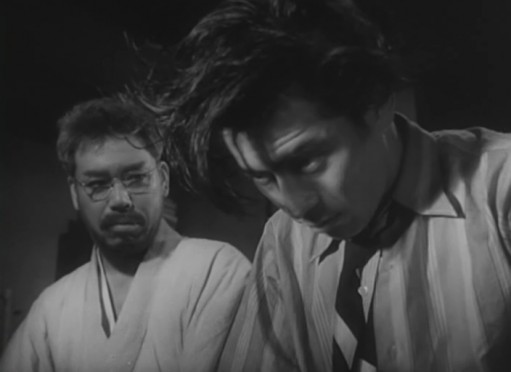
Drunken Angel (1948, Japan, Kurosawa)

As tuberculosis is to the young yakuza Toshirô Mifune, so he and his friends are to society: An infection that consumes its victim from within, and resists any half-hearted treatment.  Watched it all.

Only such voluntary departures from the truth as one considers necessary to prevent a few husbands from shooting their wives

A good reason for writing one’s autobiography is that it may prevent some jerk from writing one’s biography. And this is all to the good, if only because what one writes oneself about persons and facts one knew firsthand will contain only such voluntary departures from the truth as one considers necessary to prevent a few husbands from shooting their wives, for instance (or vice versa), as opposed to the mountains of false statements, misspelled names, wrong dates, and incorrect loci the well-meaning biographer usually comes up with after tracking one down through the morgues of defunct newspapers, the old letters of some of one’s friends, and the very unreliable memories of people who knew one slightly. This is the tremendous advantage of even the most analphabetic autobiography over even the most scholarly biography. Baron Münchhausen himself will be closer to the truth, describing what he himself has done, than the most conscientious outsider trying to relate the same thing a couple of centuries later. It is often stupefying to read a piece about somebody one knew intimately, in a time which appears still quite recent, and to discover its extraordinary inaccuracy. It makes one doubt all the history studied in school, rarely written down by those who made it.

– Preston Sturges, Preston Sturges
Anybody who goes to a psychiatrist should have their head examined!

A. Scott Berg - Goldwyn, a Biography

Samuel Goldwyn, the Hollywood producer, was by all accounts an asshole.  Many of the people who show up in A. Scott Berg’s biography of him praise him professionally, but nobody has anything good to say about him as a human being.

Being an asshole came with the job description.  You didn’t reach and stay at the top in Hollywood by being nice.  There was a place for well-meaning, intelligent, talented people in the movie business, and that place was at the feet of someone like Goldwyn.

Like most of Hollywood’s founders, Goldwyn was an Eastern European Jew, and the lesson he took from his impoverished Warsaw childhood was that you have to grab hold of everything in your reach.  Life is a competition with all the other people: Never let go, never trust, never rest, and never show weakness.

Despite his name also ending up in the Metro-Goldwyn-Mayer company name, Goldwyn spent most of his career as an independent producer, in a time when the major studios controlled the entire distribution chain.  This didn’t make him easier to work with.

But somehow it worked out, and he and all the other assholes made some really good movies.  How such awful people ended up creating such fantastic movies is a mystery worth pondering, (especially if you’re one of those who think movies should be financed by the state, and then wonder why nobody wants to see them).

The defeat of nicotine

Whenever I take the train they announce that “this is a non-smoking train”, which I find funny, because it implies that there actually is a train somewhere that you’re allowed to smoke in.  It’s like they’re teasing the smokers: Oh, we’re sorry, you just missed the train where you can smoke as much as you like.

But there aren’t any.  There are basically no indoor places outside your own home where you’re allowed to smoke any more.  I remember when it was different, but the memories are vague, and I’m not sure which of them are real.  Did I really walk into a train once where the air was full of nicotine smoke?  It’s hard to believe, but I think I did.

The smokers seem to accept their new restrictions, which I guess means we’re winning the war on this particular drug.  When we do, I’ll appreciate the result, but regret the means, and worry about the consequences.

The war on nicotine will have taught us a dangerous lesson.  It didn’t have to: It could have taught us that we should take care of our own bodies, and not fill them with things that will kill us.  Instead we have learned that when a voluntary habit carries some risk, it’s okay to harass people and control their lives until they change their behavior.

If we defeat nicotine, we did it by allying with our inner authoritarian conformist.  Will we be able to put down that which we have called up?  Will we even want to?

40’s movies marathon – part 118

A Hen in the Wind (1948, Japan, Ozu)

There’s a better way for a young mother to stay alive in post-war Japan than to sell off your last belongings.  But don’t expect any thanks from your husband, who thinks a family can survive on nothing but good intentions while he’s been stuck in a POW camp.  Watched it all.

Rogues’ Regiment (1948, USA, Florey)

And the award for least plausible Nazi Untergang scene goes to .. Watched: 8 minutes.  I hope the war criminal they’re hunting turns out to be Vincent Price.  He’s really starting to get the hang of his Evil Voice.

Road House (1948, USA, Negulesco)

This is something new – I love when that happens!  What’s new is the way Ida Lupino walks into a bar, sits down by the piano, and sings like she thinks singing is pointless but can’t think of a reason not to.  Everything bores her, but seeing as there’s nowhere else to go, she intends to chain smoke her way through life until something interesting happens.  Watched it all.

A Southern Yankee (1948, USA, Sedgwick)

You can tell this is a comedy because the title sequence summarizes the story with the use of cute caricatures.  Watched: 4 minutes.

Rope (1948, USA, Hitchcock)

Two men kill their friend just to see what it feels like.  It feels good.  Rope is maybe my favorite movie ever.  I rewatch it every chance I get, and it’s comforting to know that, even if I hadn’t discovered it already, I would have today.  Watched it all.