1950s movies marathon – part 95

The Battle of the River Plate (1956, UK, Powell & Pressburger)

The story of a single battle in the South Atlantic during the early days of World War 2. Watched it all. Powell & Pressburger made some of the best movies of the 1940s. After some excessively operatic movies in the 50s, it looks like they’re now back on earth, with a movie that builds up slowly like a symphony of naval warfare.

La Sorcière (1956, France)

A French engineer comes to work in a remote and backwards Swedish village, where he meets a beautiful witch, but before she can bewitch and seduce him, and condemn him to spend the rest of his life in a sinful orgy of earthly Swedish pleasures, the helpful villagers come to his rescue by lynching her. Phew! Watched: 2 minutes.

Love Me Tender (1956, USA)

Watched: 2 minutes, and the music. Never mind the movie, which is just good enough, let’s talk about Elvis. Having fast-forwarded through more or less all the musical movies of the 40s and 50s, I can confirm that, although before Elvis there was something, he makes it all seem like nothing. You could say the same thing about rock’n roll in general, but with Elvis, there’s more. In the live clips of him I’ve seen from 1956, it’s like you’re watching a god of entertainment, descended down to earth to walk among mortals. All this is old news, but there is a difference between knowing something, and feeling it. Now I feel it.
Minireview: MacKay – Sustainable Energy

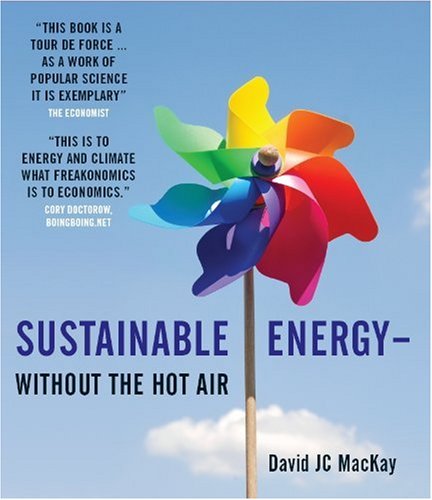
David J. C. MacKay – Sustainable Energy – Without the hot air (2009)

A back-of-the-envelope approach to what it would take to run the world entirely on renewable energy. MacKay more or less dismisses large-scale wind, wave and bioethanol farming, (the W/m2 and W/m ratios are too low), but he does believe in electric cars, (because they’re more effcient, and enable non-fossil electricity), trains (very efficient, even at high speeds), and biking, (the most efficient mode of transport of them all, even when we take your food into account). He concludes that a renewable lifestyle in our time is at least theoretically possible by using a large amount of solar desert power and/or nuclear power. Whatever we do, it has to be big, not half-hearted “unplug your phone charger” campaigns. “If everybody does a little, we achieve only a little.”

Recommended: Strongly, for the numbers-literate and visual approach, although the specifics are unconvincing. For instance, he uses the known reserves of uranium to conclude that we’re in danger of soon running out of it, if we used it as a primary energy source. Judging from the notes, it seems he is aware of how meaningless this value is for his purpose, (exploration is driven by prices, we find when it’s profitable to go looking), but he still uses it. Why? Garbage in, garbage out. Also, how relevant is “renewables only” as a near-future goal? The result is a thought experiment, although an interesting and well presented one.

Minireviews: Mill on Liberty, Lawson on global warming

John Stuart Mill – On Liberty (1858)

The only legitimate reason for restricting a person’s liberty is to prevent direct harm to someone else. Or if they belong to a backwards or barbaric society. Or if the state perceives itself in peril. Or they’ve offended against decency. But apart from that, I mean.

Recommended: Of course. You could drive a T-72 tank through the loopholes here, but this book presents some of the clearest arguments ever made for individual freedom, (although promising more than reality could deliver). I last read it 15 years ago, and was surprised to recognize ideas that I didn’t consciously pick up then, but have arrived at later.

Nigel Lawson – An Appeal to Reason: A Cool Look at Global Warming (2009)

The climate change scenarios for the year 2100 do not justify drastic action on our part. The future will be richer than we are, so why make a large investment just to improve the already high GDP of our super-rich grandchildren? The other negative effects of global warming will be slow in coming, and can be compensated for in the same way humans have always responded to negative change: By adaptation. Besides, there’s really nothing we can do without India and China, and it is absurd to expect them to take on this expense.

Recommended: Yes. Lawson’s mild skepticism of AGW is superficial, but “it’s too expensive, plus futile” is a pretty strong argument against abandoning fossil fuels. Stronger than “we’re taking a risk with a downside of unknown size”? I don’t know.

Minireviews: George R. R. Martin, energy alternatives

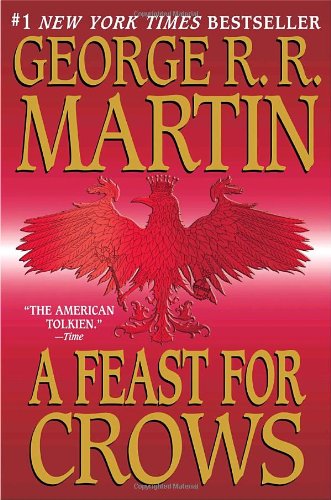
George R. R. Martin – A Feast for Crows (A Song of Ice and Fire, book 4) (2005)

In A Song of Ice and Fire, multiple political actors operate with different maps of the same terrain, leading all to disaster. Good intentions don’t protect you from making blunders, and the most dangerous characters are not the greediest and most ambitious, but the ones who execute their greed and ambition – or their good intentions – incompetently. It’s a world where the major players tend to be unaware of many of the most important events that are currently happening around them. In other words, much like the real world.

Recommended: Yes, and never mind the so-and-so HBO series, which is a competent visualization but does not approach the novels.

Burton Richter – Beyond Smoke and Mirrors – Climate Change and Energy in the 21st Century (2010)

An overview of climate issues, mostly focused on good and bad energy solutions. Richter favors nuclear energy, hydropower, carbon capture and storage – and increases in efficiency.

Recommended: Yes, it seems scientifically sound, and level-headed, but his faith in efficiency is economically naive: Efficiency does allow you to get the same energy for less CO2 emissions, or the same benefit for less energy, but it also makes your energy cheaper, which means we’ll use more of it. So much more that it cancels out the benefit? Who knows? Richter doesn’t even address the possibility. I guess that’s the problem with scientists venturing into economics and politics.

Medansvarprinsippet

Jeg har et innlegg i Tidsskrift for Norsk Psykologforening (!), som svar til psykolog Arne Klyve, som mener at alle som har bidratt med ideer til Breiviks verdensbilde, har et medansvar for det han gjorde. Jeg forsøker å vise hvor absurd dette blir hvis man skal bruke det samme prinsippet på alle former for politisk vold.

Arne Klyve kommer med to påstander om hvordan vi bør forstå terrorangrepet Anders Behring Breivik utførte 22. juli 2011. Den ene er at for å avklare medansvaret for angrepet må vi nøste opp alle former for fordommer og hat mot muslimer, feminister og venstreorienterte som kan ha påvirket ham. Den andre er at forklaringen bør søkes ikke først og fremst i individet Behring Breivik, men i de strukturelle problemene som marginaliserer enkelte unge menn og gjør dem sinte og frustrerte.

Påstandene har en del underlige konsekvenser hvis vi tar dem på alvor.

Les resten hos Tidsskrift for Norsk Psykologforening.

1950s movies marathon – part 94

Earth vs the Flying Saucers (1956, USA)

The highly advanced race of aliens who arrive at Earth are a bit clumsy at first contact situations, aren’t they? Send a message nobody understands, then randomly destroy everything in sight when your storm trooper ambassador is understandably shot at by confused earthlings. And when they later go to full-scale war, it’s not at all clear what they’re trying to achieve. Watched it all, colorized, of course – almost always watch the colorized version, especially a pure effects movie like this. Few filmmakers in the B&W era would have said no to color if they’d had the budget.

Helen of Troy (1956, USA)

This movie has a serious casting problem. Helen of Troy is supposed to be most beautiful woman of her time, but her maid is played by the woman who really was, Brigitte Bardot. Watched: 5 seconds of the overture, (yes it’s one of those), plus the obligatory decadent banquet scene, which is short, but makes up for it by being extra decadent.

Giant (1956, USA)

Like Rock Hudson’s Texas ranch, this movie goes on forever. I’m probably not the first person to make that observation. This is the sort of movie that gives you time to think of things like that. It’s also a pretty good story about life, family, land, and oil, at least for the first five or six hours, until James Dean’s makeup and the force-fed message of racial equality grinds you down. Watched it before, and again now.

1950s movies marathon – part 93

The Man in the Gray Flannell Suit (1956, USA)

A New York PR professional with a family in the suburbs who has bad memories from the war – now that sounds a bit familiar. This is basically a prequel to Mad Men, especially the way it looks and feels. Watched it all. The novel is probably better, but this isn’t too bad. It’s also a good war movie, (through a rare good use of flashbacks). The war scenes feel like they were made by people who actually fought in the war, unlike most 50s war movies, which feel like they were made by the little brothers who stayed home and dreamed of glory.

Godzilla – King of the Monsters (1956, Japan/USA)

This is the original Godzilla, mixed with new footage of an American journalist who pretends that he’s part of the plot, like someone crowding in on a photograph he doesn’t belong in. Watched: 4 minutes.

Disneyland Dream (1956, USA, Barstow)

A home movie shot by a family that won a vacation to Disneyland, goofing off with a camera along the way. It’s amazing. After all these movies, it’s like watching an entire age take off its Hollywood mask and reveal its inner self to be a cheerful, dorkish family of five. Watched it all. (And you can, too, at the Internet Archive.)

Minireviews: Somalia, Clemet

Mary Harper – Getting Somalia Wrong? (2012)

Post-colonial Somalia was cursed twice, first with a Marxist dictatorship from 1969 to 1991, then with a state of anarchy and/or civil war fueled by a self-destructive clan system, which has lasted up to the present. The early 90s humanitarian mission failed because outsiders didn’t understand the society they were trying to help, and they often still don’t. There is no central authority in Somalia. Some regions, like the de facto independent Somaliland, do relatively well. South and central Somalia is controlled by the al-Qaeda affiliate al-Shabaab, who are the worst of the worst, yet receive substantial support (both money and suicide volunteers) from the diaspora. In addition, the Somali ethnic group is larger than Somalia proper, creating among some a dream of a Greater Somalia. On the positive side, the lack of central authority has liberated parts of the economy, enabling Somalis to create one of Africa’s most extensive cell phone networks, and the trust network provided by the clan system enables an advanced, global money transfer system.

Recommended: Yes.

Marius Doksheim, Kristin Clemet – De nye seierherrene (2012)

Although immigration has introduced many challenges to Norway, every single one of those challenges has an upside to it. Every single one. Our only major immigration problem is that we don’t have enough of it.

Recommended: No. I like optimists, and instinctively I’m one of them, but I don’t trust them.

1950s movies marathon – part 92

Over-Exposed (1956, USA)

I’m not saying it’s okay that Cleo Moore has to be exceptionally talented, hard-working, wise to the sneaky ways of men, and also ruthless, in order to make a career as a woman photographer, but it’s certainly more inspirational than the idea that equal opportunity should apply to mediocrities as well. Watched it all. It’s only a moderately good movie, one of those pseudo-feminist movies Hollywood has been making since the 30s about successful career women who, on second thought, decide in the end that she’s better off marrying that whiny boyfriend who resents her ambition than with making lots and lots of money at the top of her profession. Ambition almost kills her. How convenient!

Who Done It (1956, UK)

Benny Hill looked sleazy even back in 1956. There’s just something about his face. Watched: 10 minutes.

Forbidden Planet (1956, USA)

Leslie Nielsen lands on a planet that hasn’t been informed that Freudianism has been discredited back on Earth, and thus triggers a planet-scale sex and violence-related neurotic breakdown. Watched it several times before, and again now. It’s perfect. The least interesting thing you can say about this movie is that it has a bit of The Tempest in it. As if the reason this movie is good is that it features a father and a daughter who lives in isolation, and not, you know, the actual story itself, which is completely different.

1950s movies marathon – part 91

Storm Center (1956, USA)

Bette Davis believes that her small-town library should have books of all kinds in it, including pro-Communist propaganda, even if it makes some people angry. It’s a matter of principle, of being brave enough to expose yourself to ideas you disagree with. Watched it all. There actually weren’t all that many red scare movies in the 50s, and anti-red scare movies like this were better made, anyway. This one captures the mystical commitment librarians and book lovers throughout the ages have felt to the Idea of the Library as an intellectual free zone, a theme that for some reason feels relevant to some other things I’ve been writing about lately. (The child actors are awful, though. And the story is didactic, but I agree with the message, so I don’t mind.)

Et Dieu… crea la femme / …And God Created Woman (1956, France)

I wonder if there were people in the 50s who swore that they watched Brigitte Bardot movies for the plot and the dialogue. Watched: 10 minutes. I hate French movies, I really do. Even when they have such an .. interesting plot and well-formed dialogue as this one. It’s not a prejudice, I’ve given them every chance, but it almost never works.

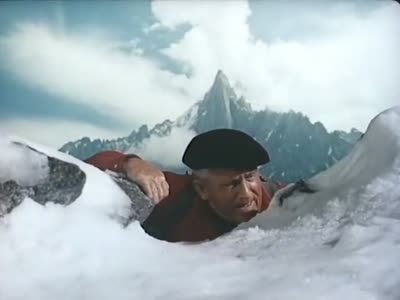
The Mountain (1956, USA, Dmytryk)

The sets and scenery in this climbing movie are so spectacular that you hardly notice the characters, although they’re interesting in their own respect: Aging mountain climbing Spencer Tracy and his greedy asshole grave robber of a brother. Watched it all.