Why Did Teen Suicides Increase Sharply from 1950 to 1990?
Gray, Peter. 2023-09-18.
Vinklinger
-
Psykisk helse: Gradvis innskrenkning av frilek og uavhengighet førte til en sterk økning i selvmord blant amerikanske tenåringsgutter fra 1950 til 1990.
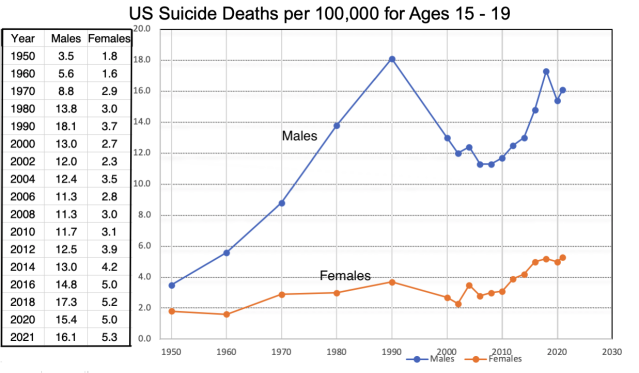
A large sex difference in suicide rate is found not just for teens, but also for people of all ages. Generally, it is reported that girls and women attempt suicide more than do boys and men, but boys and men complete it more. To this I should note that suicide experts acknowledge that the label “attempted suicide” can be misleading. If a person “attempts suicide” but doesn’t die, was it an actual suicide attempt or was it a cry for help, a dramatic message saying, essentially, “I can’t go on unless something changes here.”
I have long been contending, with much evidence, that the primary cause of the huge, almost linear increase in suicides over four decades was a continuous decline in the freedom of children and teens to do what they must do to be happy and to develop the character traits (such as courage) required to deal with the bumps in the road of life (Gray, 2011, 2013; Gray, Lancy, & Bjorklund, 2023).
Historical research, reports by social scientists over the years, analyses of advice-to-parents articles in popular magazines—as well as my own lived experience—make it clear that children and teens in the mid-20th century and earlier had far more freedom to play, roam, explore, socialize, take risks, contribute meaningfully to their community, and do all the things that make young people happy and help them develop the character traits that promote resilience than they do today (Gray, Lancy, & Bjorklund, 2023). Freedoms were not just suddenly taken away; they were gradually taken away. Because it occurred gradually, many people did not notice the change, or if they did, they thought of it as small because the year-to-year change was small. But over that whole 40-year period, it was huge.
I’m tempted to call this theory of the rise of suicide the imprisonment theory, because over these decades children and teens were increasingly imprisoned in school and at home. But, to avoid sounding as angry as I truly am about what we have done to kids, I’m calling it the constraints on independent activity theory.
I have long been convinced that the major cause of the rise in anxiety, depression, and suicide among teens after 1950 is the ever-increasing constraints on their freedom to play, roam, associate freely with peers, and in other ways engage themselves in the real word.