Why Did Teen Suicides Decline Sharply from 1990 to 2005?
Gray, Peter. 2023-10-01.
Vinklinger
-
Psykisk helse: Selvmord blant amerikanske tenåringsgutter falt fra 1990 til 2010 fordi datateknologi ga dem tilbake noe av den uavhengigheten de hadde mistet i tiårene før.
-
Gaming: Dataspill oppfyller våre tre mest grunnleggende psykologiske behov: Uavhengighet, kompetanse og tilknytning til andre, og har en positiv effekt også på barn.
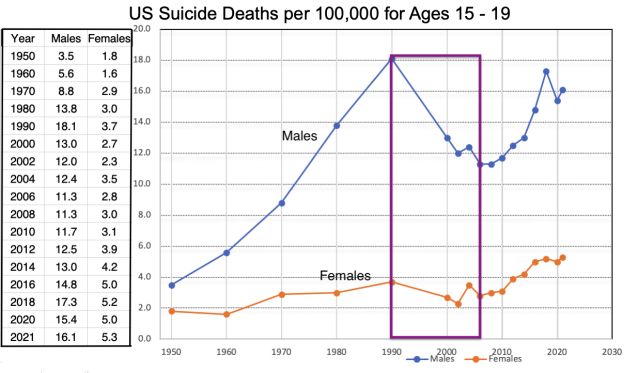
My main contention, in the last post, was that over the 40 years from 1950 to 1990, children and teens were increasingly deprived of opportunities for free play and other independent activities (activities not governed or monitored by adults)—the kinds of activities that promote immediate happiness and also allow kids to develop the courage, confidence, and a sense of agency required to meet the challenges of life with equanimity.
Over those 40 years, we were increasingly “protecting” children from what we perceived as possible dangers, increasingly teaching them and guiding them, leaving them ever less opportunity to learn how to create and direct their own activities and solve their own problems. The result, over time, was a decline in what psychologists call an internal locus of control—the sense of being in control of one’s own life and able to solve life problems as they arise.
Much research shows that people of all ages who lack a strong internal locus of control are vulnerable to anxiety, depression, and suicide. Without opportunities to learn how to control their own activities and solve their own problems, people develop a sense of helplessness, which is almost the definition of anxiety, and of hopelessness, which is almost the definition of depression.
Now, for the first time, I present what I think is a novel theory for why the suicide rate, especially for boys, declined sharply from about 1990 to about 2005. My theory, in brief, is that computer technology and video games brought a renewed sense of freedom, excitement, mastery, and social connectedness to the lives of children and teens, thereby improving their mental health.
If you are old enough to have been parent to a teenager around the year 1990, you may recall that your kid was the one clamoring for a home computer. Kids nearly always, everywhere, glom on to new technology and become skilled at it before adults do. (This may be a topic for a future post.) Once you brought such a device into your home, your kid most likely learned to use it before you did, and when you finally, gingerly, tried to learn it your kid taught you how. Wow. A role reversal. Your kid is the master; you’re the apprentice.
So, I suggest, there was a time when, to a considerable degree, teenagers (and sometimes younger children, too!) were valued for their remarkable ability to figure out this new technology and teach it to us slower-witted adults. That must have increased kids’ sense of agency and decreased their depression and despair.
Sociologists and anthropologists who have studied children worldwide have observed that children normally—in other cultures and in ours until about half a century ago—grew up in a “culture of childhood.” That is, they grew up in a world where they had almost continuous social interactions with other children, outside of adult control. This is where they learned how to initiate their own activities, solve their own problems, create and follow rules, get along with peers, and deal with bullies. In short, this is where they acquired the skills of independence required, eventually, for adult life.
Following this thread, one way of describing changes in kids’ lives beginning around 1990 is that digital technology, to a considerable degree, restored a culture of childhood. Kids still could not engage in adventures and connect with other kids outdoors, because of our unreasonable restrictions on them, but they could engage in adventures and connect with other kids digitally, especially through video games.
Near the beginning of the 21st century, researchers conducted extensive studies aimed at understanding why video games were so popular. What were kids getting from them?
One group of researchers (Przybylski, Rigby, & Ryan, 2010) approached this question from the vantage point of Basic Psychological Needs Theory. According to this theory—which is supported by literally hundreds of research studies with people of all ages—mental health depends on the satisfaction of three basic psychological needs: autonomy (the freedom to make one’s own choices), competence (the sense of being good at a self-chosen task), and relatedness (feeling connected to peers). In an extensive set of studies—including surveys and focus-group discussions with kids about why they like the games, analyses of the difference between games that became most popular and games that flopped, and laboratory studies in which kids played video games and reported on their feelings before, during, and after the game—the researchers concluded the games are popular because they are so powerful in satisfying the three basic needs.
But do video games actually, in the long run, improve mental health? The research conducted to date strongly suggests “yes.”