Why Did Teens' Suicides Increase Sharply from 2008 to 2019?
Gray, Peter. 2023-10-10.
Vinklinger
-
Psykisk helse: Mer resultatfokus og stress på skolen er årsaken til at selvmordsraten blant amerikanske tenåringsgutter begynte å stige igjen i 2010-årene.
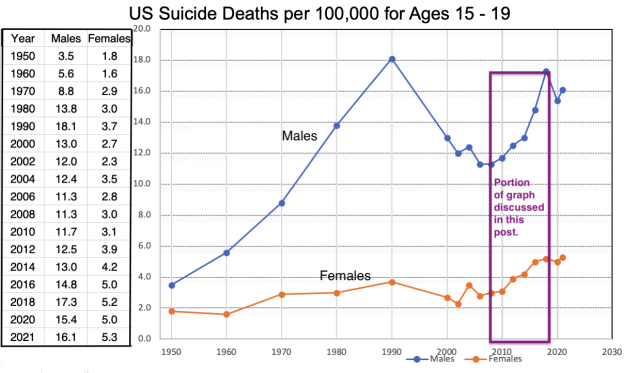
Now, in this post, I present and support a theory about the final portion of the suicide curves shown the graph, the sharp increase in suicides from about 2008 to 2019 (the year just before the COVID pandemic).
My theory, in brief, is that during this period schooling became far more stressful and damaging to mental health than it had been before, and this resulted in increased rates of anxiety, depression, and suicide among students. The damaging changes in schooling resulted from the No Child Left Behind (NCLB) Act, which became U.S. law in 2002, and the Common Core Standards Initiative, introduced by the federal government in 2010 as follow-up to NCLB.
In support of the theory, I present here evidence that (a) NCLB and Common Core indeed did alter schooling in ways that would reduce the fun and increase the pressure; (b) children and teens themselves attribute their high levels of stress and anxiety more to school pressure than to any other cause; (c) rates of attempted and actual suicides for students are much higher when school is in session than when it is not; and (d) academic training and testing in preschool and kindergarten—brought on by NCLB and Common Core—have long-term harmful effects on children’s development.
Reviews of how schooling changed over the period following these federal interventions have regularly pointed to a reduction in creative and enjoyable activities and increased focus on drill for high-stakes tests.
There’s an old saying in humanistic psychotherapy that goes something like this: “If you want to know what is bothering someone, ask them.” Concerning the rise in anxiety and depression among kids in recent years, adults have produced a variety of guesses, based on their own suppositions. But if you ask kids themselves, you get a remarkably consistent answer. What’s bothering them is school.
Research conducted in recent years has shown that rates of mental breakdown and suicide are much higher for students during months and weeks when school is in session than during vacations from school.
Experiments comparing students who were in academic preschools or kindergartens with those who were in play-based preschools or kindergartens have routinely shown that by third grade and beyond, the former are socially, emotionally, and even academically disadvantaged compared with the latter.
Compulsory schooling, where students are forced to learn (or go through the motions of learning) in ways that do not match their natural ways of learning, has never been good for children’s and teens’ mental health (see Gray, 2013). But changes brought on by No Child Left Behind and Common Core have clearly made schools worse in this regard than they were before. Children’s and teens’ own reports, and the timing of mental breakdowns and suicides over the school calendar, make it clear that school has become a major source, if not the major source, of psychological distress for American children and teens.
This is a difficult conclusion for most adults in our society to reckon with. Most adults would rather attribute young people’s distress to almost anything else. The research studies I have described here are almost never reported in the popular press. A tiny correlation between social media use and anxiety in girls gets major press coverage with sometimes dramatic headlines, but a study showing that 83% of teens cite school pressure as a major source of distress, far more than any other cause, or that teens’ rates of mental breakdowns and suicides are about twice as high when school is in session as when it is not, gets essentially no coverage at all.