Has Social Media Harmed Teens' Mental Health?
Gray, Peter. 2023-11-02.
Vinklinger
-
Psykisk helse: Forskning gir lite støtte til teorien om at sosiale medier skader ungdommer psykiske helse. Effekten er uklar og liten.
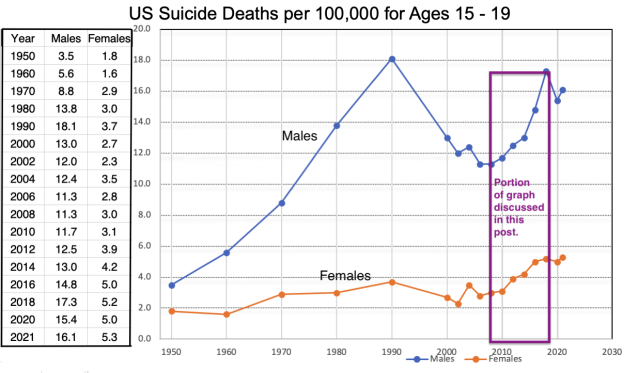
My goal in the present post is to examine evidence relevant to the popular theory that teens’ increased use of digital technology, and particularly their increased use of smartphones and social media, is a major cause of their increasing rates of anxiety, depression, and suicides from 2008 to 2019. My conclusion—consistent with the conclusion of the great majority of behavioral scientists who have published research on this question—is that digital technology probably has some negative effects on young people’s well-being (and some positive effects, to be discussed in a future post), but the negative effects are too small and inconsistent to explain the sharp decline in mental well-being over this period.
The research aimed at understanding the relation of teens’ uses of digital technology to their mental health is of three main types: cross-sectional correlational studies, longitudinal correlational studies, and random assignment experiments.
Many dozens of [cross-sectional correlational] studies have been conducted, and at least 10 independent reviews of them have been published. Some of the studies show positive correlations between digital technology use and mental well-being, some show negative correlations, and some show no correlation. Overall, the reviews reveal that, taken as a whole, the studies reveal a small negative correlation between measures of digital technology use and indices of mental health. This is true regardless of whether the measure of technology use is total screen time, total time on a smartphone, or time on social media platforms. Most reviewers conclude that the correlation is statistically significant in large samples but too small to be of practical significance.
One way of trying to establish direction of causation is to conduct longitudinal correlational studies. In these studies, research participants are assessed for their technology use and mental health at two or more points in time. A correlation of high social media use at time 1 with reduce mental health at time 2 suggests that social media use is a cause of decline in mental health. Conversely, a correlation of poor mental health at time 1 with increased social media use at time 2 suggests that reduced mental health may be a cause of increased social media use.
An example of such a study is that conducted by Abigail Bradly and Andrea Howard (2023) with 187 university students as subjects. Each week for 12 weeks the students submitted screenshots of their iPhone “screen time” settings display and completed surveys measuring stress and mood. The results showed no significant correlations over time in either direction. Heavier smartphone use in a given week did not predict end-of-week mood states, and higher stress levels did not predict increases in smartphone use. The researchers concluded, “Our findings contribute to a growing scholarly consensus that time spent on smartphones tells us little about young people’s well-being.”
Random-assignment experiments are commonly regarded as ‘the gold standard” of research aimed at showing causation, but, as I will point out, they are seriously flawed when used in research on effects of social media.
Many experiments have now been done in which the subjects (usually college students) are randomly assigned to an experimental group or a control group. The experimental group is asked to reduce their use of digital technology (or some aspect of it) for some period and the control group is not asked to do that. If those in the experimental group show improved mental well-being at the end of the experiment relative to the controls, that is taken as evidence that the technology use was suppressing well-being.
Such studies have shown mixed findings, much like the correlational studies. Perhaps the best example of a study interpreted as evidence for the value of reducing social media is one conducted by Manuela Faulhaber and colleagues (2023) with 230 college undergraduates. The students were randomly assigned either to limit their social media usage to 30 minutes per day or to use social media as usual for two weeks. At the end of the two weeks, those who limited social media showed statistically significant reductions in self-reported anxiety, depression, and loneliness.
This study, taken at face value, would seem to be good evidence that reducing social media use is good for mental health. However, I must note two fundamental problems that apply to all experiments of this type—problems that really negate the value of this approach.
The first problem is the placebo effect. It is well known, from countless studies, that anything that people do or take that they believe will reduce their anxiety or depression in fact does reduce their anxiety or depression, at least for a short period. This is why it is so difficult to prove that drugs for anxiety or depression are effective. The placebo effect is so large that it is difficult for any drug to have an effect more than the placebo. We can assume that subjects in social media experiments are aware of the common belief that social media use has harmful psychological effects, and it even seems likely that such awareness is what led them to volunteer to be in the experiment.
The second problem is what researchers call the demand effect. Subjects in research experiments are very good at guessing what the research hypothesis is and, consciously or unconsciously, are motivated to prove the hypothesis correct.
My own conclusion from immersion into the research on the effects of screens, smartphones, and social media is that the research is, on one score, quite conclusive. None of these account for the large recent rise in suicides (or other indices of mental suffering) in teens. The very small effects found in some of the studies have been blown up in the media in ways that augment popular prejudice.
However, the lack of a meaningful overall effect does not mean there are no problems at all with social media for teens (the same applies to the rest of us). There are both problems and benefits, and these likely play themselves out differently in different people.
Unfortunately, the societal instinct in recent times is to take away young people’s freedoms whenever we think there are dangers, rather than teach safety.