..such a governor could not ever again preside over the affairs of Takrit

“To break someone’s eye,” is an old Bedouin expression, which was turned into state policy in Iraq through the employment of a rapist like ‘Aziz Salih Ahmad. The people of Takrit were famous under the Ottomans for the way they would “break the eye” of any non-Takriti governor who  might be imposed on them by central government. The newly appointed governor, along with his wife and children, would be invited for a welcoming feast in the ho use of a local notable, On the way back, the party would be ambushed by a group of armed masked men. The governor would be forced to watch his wife being gang-raped, after which the men would whip off their masks, show the governor their faces, and disappear into the night, killing no one.  Such a governor could not ever again preside over the affairs of Takrit.  By the late 1970s, the most famous “aristocratic” Baghdadi families were having their eyes “broken” by the new upstart Ba’thi rulers, even though these families had long ceased to wield political influence or even economic power in the country. Young women from such families were kidnapped off the streets on their way to and from some of the famous clubs of Baghdad. They would disappear for a few weeks, and then reappear. Everybody would know what had happened to them, but no one would dare (or want) to say anything about it.

– Kanan Makiya, Cruelty and Silence (1993)

1950s movies marathon – part 27

Eight Iron Men (1952, USA, Dmytryk)

There are basically three types of war movies at this point: The sentimental ones that open with the Marine Corps hymn and feature John Wayne as the sergeant, the cheerful ones where the title has or might as well have multiple exclamation points, and the down to earth ones, like this: Just eight desperate characters stuck in a very bad place.  Watched it all.

The Man Who Watched Trains Go By (1952, USA)

It’s very convenient for a crime writer to have the trainspotting bookkeeper Claude Raines turn into a strangler when the plot calls for it, but I don’t believe it.  Watched: 22 minutes.  This actually feels a lot like an episode of Columbo, which isn’t such a bad thing, as crime goes, but not so special either.

The Wild Heart (1952, UK/USA)

David Selznick’s butchered version of the odd but unforgettable Powell & Pressburger movie Gone to Earth, which turned Zelnick’s wife Jennifer Jones into some sort of doomed faerie creature.  Zelznick didn’t get it, and decided to “improve it” for the US release.  Not even my favorite scene is intact.

Sailor Beware (1952, USA)

This is that movie where Jerry Lewis overcomes his nerdiness by signing up for military service, a concept so inherently funny that he and Dean Martin reused the plot again and again, and saw no need for adding additional jokes.  Watched: 8 minutes.

..my breakdown and nationalist appeal seemed to impress the interrogator

Up to this point my interrogator had been speaking very quietly. Then he suddenly screamed in a voice that almost brought the roof down.

“I shall bring him this instant and hang him up here! GUARDS! Bring his father. Bring that bastard father of his!”

The tears almost drowned me out when he said this. I couldn’t see a thing and felt like a complete degenerate for having brought such pain on the man who brought me up.

Sayyidi, God preserve you, please, sayyidi, my father is paralyzed. He was one of Iraq’s nationalist officers in 1941, He is a sick man. Please, sayyidi, God preserve and watch over you, he is a great Arab nationalist.”

My breakdown and nationalist appeal seemed to impress the interrogator. I felt he respected me for the fact that I was trying to protect my father. Maybe he hadn’t known that my father had spent four years in the prisons of the ancien regime because of his role in 1941. The Rashid ‘Ali affair in 1941 is a big thing with the Ba’thists.

The following day, when I was on my ten-second Monkey Run to the toilet, I saw Nabeel, half naked, in filthy rags, just like everyone else. Nabeel had been playing the role of informer in a big charade prepared for my benefit. He was in the same boat as I was! Worse in fact. I spent forty-two days inside and was decreed innocent, whereas he, poor chap, got life imprisonment.

– “Omar”, quoted by Kanan Makiya in Cruelty and Silence (1993)

Movie clips

My favorite part of the movie marathon is stumbling across great scenes in old movies, and putting them up on YouTube.  Clips are like the visual equivalent of a quote.  They can be used in all sorts of different contexts.

For instance, this clip from the 1949 movie Reign of Terror, where a woman is tied up and tortured by Robespierre, has been picked up by a bondage porn blog, and is now associated by YouTube with similarly themed clips from other movies.  That was .. not quite what I intended – but I don’t mind.

This mindboggling clip from the 1949 Soviet movie The Fall of Berlin, where Stalin is worshipped like a god, has gotten lots of hits from what looks like a pro-Soviet discussion forum.  I wish I knew what they were saying about it, but I haven’t found the actual thread.

My most popular clip is not from an old movie, but the recent cartoon series Sym-Bionic Titan.  According to YouTube’s statistics, it’s particularly popular with the under-18’s, (and equally popular with males and females, which is interesting for what’s basically American mecha anime).  The comments make me take back every bad thought I’ve ever had about The Kids These Days and YouTube commenters in general.  They’re adorable!

And some of these clips I like so much that I go back and rewatch them later.  They’re usually musical numbers, like Pass That Peace Pipe, Ballin’ the Jack and Harps in Heaven. Go take a look. They may make you smile. (This definitely will.)

..promptly terminated the lifeblood of the intifada

Five to ten thousand armed Iraqi Shi’ites, organized in small bands and recruited from refugees expelled by the Ba’th during the late 1970’s and 1980’s, entered the country through the marshlands around Basra on the second or third day of the uprising. They were units from the Badr Brigade, organized by the Supreme Islamic Council headed by Muhammad Baqir al-Hakim. [..] The first action of these angry young men pouring in from Iran seems to have been the storming of the Sheraton Hotel and the burning of the bars and casinos of the city of Basra. They then proclaimed the establishment of a Shi’i Islamic Republic in Basra. Surrendering or captured army personnel were executed, occasionally in “trials” presided over by clerics. These judgments were implemented on men who were in the eyes of the rebels “enemies of God”. [..]

Such violence, justified in the name of Islam, but more often than not motivated by the desire for vengeance, promptly terminated the lifeblood of the intifada: the flow of defections from the army. This explains the ability of the regime to regroup its shattered forces and strike back.  In Najaf, as we have seen, attempts were made to check the descent into anarchy by resident notables and ‘ulema‘, learned religious men, acting through the prestige of Ayatollah Khoei. But in Basra and Kerbala, whatever leadership there was came from Iraqis based in Tehran. These are also the cities where some of the worst rebel excesses occured.

– Kanan Makiya, Cruelty and Silence (1993)

1950s movies marathon – part 26

The Outcasts of Poker Flat (1952, USA)

All the people of ill repute and negotiable virtue get run out of Poker Flat, and must fend for themselves out in the wilderness, where the real bad guys roam.  Watched it all.

The Story of Robin Hood and His Merrie Men (1952, USA)

Of all the horrible adaptations of Robin Hood, this may well be among the worst. Just going through the motions, although with a delightfully campy Prince John looking like a cross between Conan O’Brian and Adam Savage.  Watched: 7 minutes.

Zombies of the Stratosphere (1952 serial, USA)

Wait, those funnily dressed bad guys from outer space are supposed to be zombies?  No.  Those are not zombies, not even the old boring kind.  Watched: 4 minutes.

Ivanhoe (1952, USA)

Oh Popcorn & Chain mail, though you haven’t posted anything for years, I imagine your commentary in my mind whenever I watch movies like this.  “Yay! Let’s go oppress the Saxons!!”  Watched: 9 minutes.

Lydia Bailey (1952, USA)

It has the feel of historical bullshit, but at least the opening scene with the Haiti drum messages is pretty awesome.  Watched: 7 minutes.

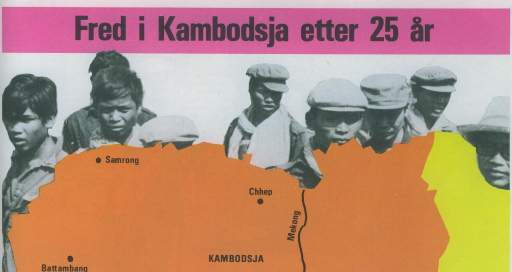
Gladnytt fra 1975: Endelig fred i Kambodsja

Det hendte 75 - Fred i Kambodsja etter 25 år

Kambodsja gjennomgikk 25 års fødselsveer

Det gamle kongeriket Kambodsja fikk gjennomgå 25 års fødselsveer før den egentlige oppbyggingen av landet i det hele tatt kunne påbegynnes.

1949. Kongedømmet Kambodsja ble en selvstendig stat innenfor den franske unionen.

1953. De pågående kampene mellom franskmenn og vietnamesere spredte seg inn i Kambodsja. Kambodsjansk gerilja begynte å delta i frigjøringskrigen mot franskmennene.

1954. Genève-konferansen satte stopp for krigen i Indo-Kina. Kampene avtok og franskmennene trakk seg tilbake.

1955. Kambodsja ble helt selvstendig. Kong Norodom Sihanouk frasa seg tittelen, men beholdt posten som statssjef. [..]

1969. General Lon Nol ble utnevnt til statsminister med vidtgående fullmakter.

1970. Fyrst Sihanouk ble styrtet ved et militærkupp ledet av Lon Nol. Statsministeren proklamerte republikk og utnevnte seg selv til marskalk. Sihanouk flyktet til Peking. USAs daværende president Richard Nixon tillot amerikanske og sør-vietnamesiske styrker å invadere Kambodsja i sin kamp mot FNL. I Peking dannet Sihanouk eksilregjeringen GRUNK.

1971. Den nasjonal frigjøringsfronten FUNK hadde stor fremgang og kontrollerte snart den største delen av landet.

1973. USAs mest intense bombing av Indo-Kina ble innledet mot FUNK-geriljaen. I august ble bombingen stanset av den amerikanske kongressen. I Kambodsja proklamerte Lon Nol unntakstilstand.

1974. FUNK rykket inn i den tidligere kambodsjanske hovedstaden Gudong. Byen ble imidlertid gjenerobret av regjeringsstyrkene, men da geriljaen innledet en kraftig offensiv ved årsskiftet, ble Lon Nol-regjeringen tvunget til å overgi den ene viktige stillingen etter den andre. USAs president Gerald Ford krevde ytterligere bevilgninger til Lon Nol-regimet, men fikk avslag av kongressen.  Dermed var også geriljaens seier et faktum.

Det hendte 75

TV roundup: Skins, Camelot, The Cape, How Television Ruined Your Life

Skins (2007-)

There’s no such thing as a real, honest portrayal of teenagers on television. It’s just a setting, a trope, like “crew on a starship flying about in space”, and all that matters is whether it has soul. This does. In fact, it may be the only show that does at the moment. Score another one in the “British show so good the Americans will make a horrible copy of it” category.

Recommended: Yes

Watched: Three seasons and counting

Camelot (2011)

Oh yes we need even more of these good-looking modern-sounding assholes parading around in the ancient past, trying to make it “fresh”.

Recommended: No.

Watched: One episode.

The Cape (2011)

You had me at vigilante teams up with circus freaks and being unashamedly cheesy. You lost me with the horrible horrible horrible writing. Possible there is a connection here, but there oughtn’t to be.

Recommended: No.

Watched: 5 episodes

How Television Ruined Your Life (2011)

Charlie Brooker doesn’t just hate television, (for many good reasons), he also believes that love is futile, and takes half an episode just to explain in tedious detail how even the most promising relationships must eventually break apart. Not the finest example of what life without television does to you, this.

Recommended: Not really, but his rants are entertaining. I miss Adam Curtis, though. He would have done this right.

Watched: All of it, so far.

Book roundup: Steampunk, Øvre Richter Frich, Ayaan Hirsi Ali, Nina Witoszek

Ann & Jeff Vandermeer - Steampunk

Ann & Jeff Vandermeer – Steampunk

An anthology of some bad, some good, bookended by diametrically opposed visions of steampunk: Jess Nevins, who argues that only by dedicating one’s art to the destruction of capitalism can one do Proper Steampunk, and Rick Klaw, who says it’s all one big party so just come on in and enjoy yourself.

Recommended: No. Stories seem selected more to display the breadth of the genre than for quality.

Øvre Richter Frich – Rød tåke (1937)

Frich is kind of a cult author in Norway for his once massively popular racist thrillers about Jonas Fjeld, an Aryan übermensch who goes about beating up anarchists.  To judge from this novel, at least, Frich is to thrillers what H. P. Lovecraft was to horror: A “bad” writer with peculiar obsessions, but a compelling way of putting them on paper.

Recommended: Ironically.

Ayaah Hirsi Ali - Nomad

Ayaan Hirsi Ali – Nomad (2010)

Everything was so much easier back when oppressed third world women kept their mouths shut and let Westerners speak on their behalf.

Recommended: Yes.  It is a relief to read current feminism that isn’t an anguished search for relevance, but actually matters.

Nina Witoszek – The Origins of the ‘Regime of Goodness’ – Remapping the Cultural History of Norway (2011)

What a pleasant surprise: A look at the roots of Norway’s identity that is genuinely insightful, or at least quite interesting. Witoszek discounts Romanticism as a factor in Norwegian cultural history, and traces our identity to a meeting between peasant individualism, Christianity, and Enlightenment values – plus a dash of homegrown Taoism.

Recommended: Yes.

1950s movies marathon – part 25

The White Reindeer / Valkoinen peura (1952, Finland, Blomberg)

It’s 1952 now in the marathon, and I find myself impatiently fast-forwarding through the same-old, same-old, even through movies I might have watched in a better mood. But that’s okay. The whole point of this project is to lean back and demand to be intrigued, to be forcefully pulled into something new, different, unexpected. Something like this, about a Sami woman who dabbles with shamanism and turns into a reindeer vampire, who stalks the snowy plains of Finland, looking for men to suck dry.  W00t?!  Yes!  Watched it all.

Ellis in Freedomland (1952, USA)

A failed salesman gets a lecture from a talking refrigerator about how to sell it.  Watched 10 minutes, then fast forwarded through 80 minutes of talking dishwashers, ovens, etc.  A suspicion creeps up on me: Is this in fact not a real movie, but a training video for dealers of Westinghouse kitchen appliances?  Yes.  Yes it is.  I feel .. violated.

Jumping Jacks (1952, USA)

Jerry Lewis and Dean Martin clearly has the potential of being funny.  But I’m a little disturbed by Lewis’s nerdiness always being presented as some sort of horrible debilitating disease that he must learn to overcome.  What is this, the 50’s?  Watched: 6 minutes.

The Girl in the Bikini / Manina, la filles sans voiles (1952, France)

There may be some sort of plot going on here, but I don’t think anyone noticed, what with (introducing) Brigitte Bardot being right in the middle of it.  Watched: 10 minutes.