Media ideas that feel dated

It may just be me, but here are some media and technology ideas that right now feel a bit dated.  Not much, just enough that I pause a little when I encounter them, and think “yes, but ..”:

– That everything must be connected with social media.  That there must always be a “tweet this” or “like this” button, everywhere.  (But whenever I see a Facebook box that says “hey, we notice you’re visiting this site – here are some of your friends who like it too!” it freaks me out.)

– That everything must have an URL.

– That everything must be free, or noone will care.

– That everything must be personalizable.  (I don’t want my search results and App Store bestseller lists adapted to where I live.  I do want to pick and choose from media sources, but I want each of them to speak with their own voice, not ask me what I want to hear about.)

– That the best sources of information are automated or crowd-sourced.

It’s not new that I am skeptical of these ideas.  What’s new is that they now feel over-extended as well, and their promoters just haven’t discovered it yet.  Again, it may be just me.  But here is one thing that does not feel dated:

– Anything, no matter the format, that is well-written, well-made, well-selected, well-presented, by individuals with a vision of what they want to create.

There’s not necessarily a conflict here.  It’s about what feels relevant.  The last one does, more than ever.  None of the others do.

1950s movies marathon – part 19

The Tales of Hoffmann (1951, UK, Powell & Pressburger)

Powell and Pressburger have gone and filmed an opera!  They’re mad!  Mad!  Watched it all.  This is basically the two hour equivalent to the ballet scene in The Red Shoes.  As with all their movies, my reaction is partly amazement that such a thing can exist at all.   Unlike most of their movies, though, that amazement is more or less all there is to it. But still .. !

Let’s Make it Legal (1951, USA)

So now Marilyn Monroe is at third billing, and rising.  Watched: 3 minutes, then fast forwarded to find her scenes.  I still don’t quite get Marilyn Monroe.   There’s something annoying about the way she slurs her words.  Did she get less annoying later?

Varieties on Parade (1951, USA)

Hey this is unexpectedly enjoyable: It’s a vaudeville show put on film, with no stupid plot lines or stars, just ordinary vaudeville stars doing stand-up, acrobatics, music, animal tricks, magic, etc.  And it’s actually really enjoyable.  Friendly.  Watched it all.  It’s .. it’s the Muppet Show.  I finally get the Muppet Show now!  They were doing vaudeville with puppets!

Appointment With Danger (1951, USA)

So, in the series of movies based on the Exciting! Thriller! Breathtaking! Death-defying! life of government officials, we’ve now come to the postal inspector?!  Is this for real?  Watched: 3 minutes.

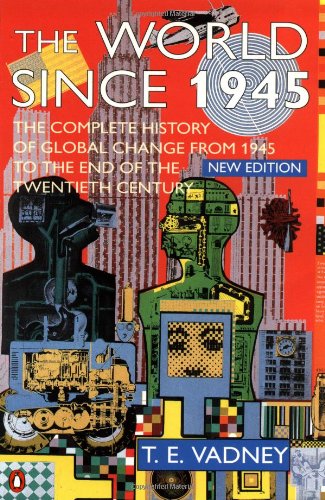
T. E. Vadney – The World Since 1945

T. E. Vadney - The World Since 1945

Broad histories of the recent past tend to start out focused, and then gradually degenerate into news-media like ADHD, leading us up to the “chaotic” present.  So with T. E. Vadney’s The World Since 1945, which, having been published in three editions since 1987, has an unusually long such news-like section.  And then this happened, and then this happened, and today it’s just all a big mess!

The early parts of the book, about the Cold War and the end of colonization, have their biases too.  Vadney prefers to explain the actions of states by what is in their strategic interest, (“it was in their interest to” is used so often as to become a cliché), and less by their beliefs.  I suspect he goes too far.  But it’s all interesting and perceptive, clearly the result of this material having been pre-digested by several generations of historians before being summed up by Vadney.

As we reach the present (80’s and later), the digested analysis gives way to poorly written news cavalcades that wouldn’t be out of place in a Wikipedia entry.  The bias becomes more clearly leftist – the election of Ronald Reagan is ascribed ominously to the rise of the “militant right”, and economic inequality of any sort is sternly admonished.  What’s most annoying are the lazy, empty formulations, like summing up the Koreas in the 1990’s by saying that they both had “problems”.

But then, nobody gets recent history right.  And I like the early part enough to forgive Vadney not achieving the impossible.

Cut adrift in a sea of pointless entertainments

“The myth-maker points to the past but speaks in the voice of future history; it is the collective voice of our ancestors, speaking through us, giving us a sense of continuity and destiny; it makes connections between those who have preceeded us, and those who will follow us. Absent those myths, we are cut adrift in a sea of pointless entertainments intended primarily to divert us from our own lives.

It is not the task or responsibility of television to teach your children, or babysit them, or take the place of conversation, or reinforce societal mores, or make you feel good about your neighborhood or your job or your prejudices or your sexual orientation or your odds for hair restoration.

When television took center stage in the world of collective and mass story storytelling, it took on the responsibilities of providing new myths, fictions that point the way toward tomorrow, that remind us that there will be a tomorrow, a better one or a poorer one depending on what we do right now, and that we can’t ever afford to lose sight of that. In short…to rekindle in hearts of millions a sense of wonder, about the world, the future and our place in that future.”

- J. Michael Straczynski, Approaching Babylon, (a 1995 essay about why he created Babylon 5)

1950s movies marathon – part 18

The Day the Earth Stood Still (1951, USA, Wise)

The first plan from outer space was to send a giant robot and ask nicely.  Watched it before, and again now.  I don’t think I appreciated the last time I saw it how few science fiction movies (good or otherwise) had been made at this point.  And it demonstrates nicely SF’s potential for portraying ideas that are too big for realism.  In this case, it’s a stupid idea, (Plan 9 with better writing), but this is still a fantastic movie.  And the music .. yes!

My Favorite Spy (1951, USA)

Having successfully ruined 1940’s comedy, Bob Hope now hopes to set his mark on the 1950’s as well.  I hope they don’t let him.  Watched: 4 minutes.

Der Untertan - The Kaiser's Lackey (1951) - Werner Peters

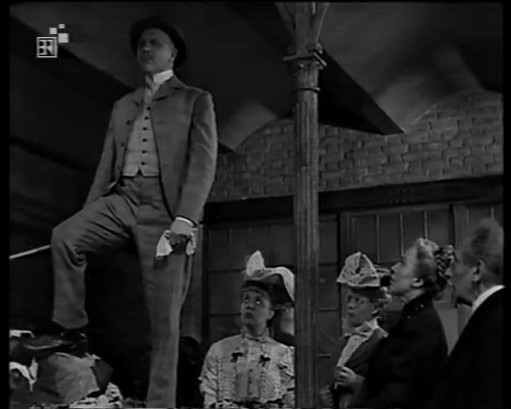
The Kaiser’s Lackey / Der Untertan (1951, East Germany, Staudte)

What Werner Peters respects more than anything else in life is a display of raw Macht.  He allows himself to be subjected to the will of others, so that he may in turn subject others to his.  Generations of Kaiser worship have thus succeeded in creating the Perfect German.  Watched it all.  Wow, these guys have an even bleaker view of the course of German history than A. J. P. Taylor.

The Axe of Wandsbek (1951, East Germany)

I’m playing a game with these German movies.  I try to guess if they were made in East or West.  This one features two references to Nazi persecution of Communists in the first minutes, so my guess is Eastern.  Watched: 7 minutes.  (I was right.)

1950s movies marathon – part 17

Ace in the Hole (1951, USA, Wilder)

A bunch of Chilean miners are stuck down in a cave somewhere, and Pulitzer-aspiring journalist Kirk Douglas is more than happy to turn it into a media circus.  He’s a bastard, but he’s a new kind of bastard, in touch with the low, greedy soul of the times.  Watched it all.

Bahar (1951, India)

Watching a comedy from a foreign culture can be an odd experience. It’s like it’s randomly phasing in and out of the funny zone. But this isn’t too strange.  It’s basically the Indian version of the old Hollywood formula: Wealthy airheads and their romantic troubles, interrupted by song and dance.  Watched: 31 minutes.

The Tall Target (1951) - Dick Powell

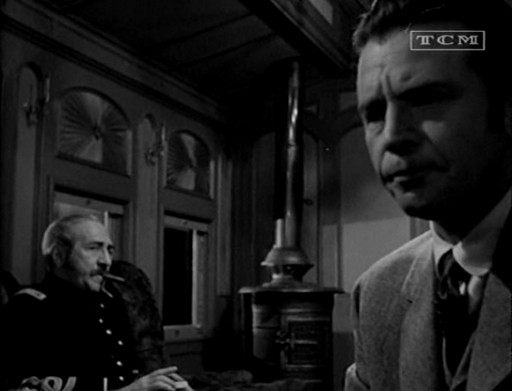
The Tall Target (1951, USA, Mann)

Dick Powell is on the train to Baltimore, and so is Abe Lincoln’s assassin.  Watched it all.  Every time I start an Anthony Mann movie, I promise myself not to be biased by how fantastic his previous movies have been. Maybe this one won’t be so good.  And almost every time, I find myself sucked into the movie, scene by scene.  Mann is the director Hitchcock is often credited to be, and for far less money too.  And this is one of his best movies, the kind of cramped, focused thriller Hitchcock (let’s be honest now) only rarely succeeded in making.

Miss Julie / Fröken Julie (1951, Sweden)

Everyone in the Swedish countryside is absolutely despicable.  They do nothing but humiliate, laugh at and beat each other all day.  Why, that’s terrible!  Watched: 13 minutes.

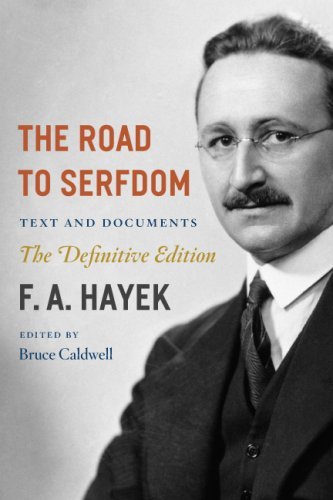
Hayek – The Road to Serfdom

Hayek was, of course, wrong.  Despite the disingenuous introduction by Bruce Caldwell, which tries to absolve Hayek from having made any predictions, Hayek did argue in The Road to Serfdom that when you take small steps of socialism, you’re walking on the road to totalitarianism.  70 years later, perhaps no country, or at most very few, have completed that journey.  There are many roads to serfdom, but democratic socialism appears to be a difficult one.

But then, all predictions are worthless, except as statements about the present, and Hayek’s description of the deadening effect of socialist ideas on an otherwise free society in the present has aged much better.  This, now, is both history and contemporary: The inefficiency of nationalized industries, the moral hazards of the welfare state, the creeping power of benevolent central planners.  Socialist ideas create stumped humans, who think not in terms of choices and consequences, but of power and entitlement.

The tragedy that haunts Hayek in this book is the deteriorating effect socialist movements have had on the liberal foundations they often believe they improve on.  This is not much less relevant now than in the mid-40’s.

But his decision to project this trend into the future, by comparing it to Germany’s own road to serfdom, makes it unfortunate that The Road to Serfdom is most people’s introduction to Hayek.  After all, anyone but an apologist can see that he got this embarassingly wrong.  Serfdom is a good  pamphlet otherwise, but the Hayek everyone should be reading instead is The Constitution of Liberty.

1950s movies marathon – part 16

The Whip Hand (1951, USA, Menzies)

Angus MacGyver stumbles into one of those small towns where everyone conspires to hide a Horrible Horrible Secret.   Naturally he starts Asking Questions, and will soon discover that the town is secretly ruled by gangsters, Communists, or possibly even Nazis.  Watched it all.  Spoiler: It’s actually ex-Nazis working for the Communists, and in the end the police shoots them all dead with machineguns.  Hell, yeah!  Er .. I mean, how uncivilized.

Tom Brown’s Schooldays (1951, UK)

Life at Hogwarts can be difficult, but also a source of valuable life lessons, etc. etc. Yes but where’s Flashman, the famous spin-off character?  Ah, here he is.  Watched: 9 minutes, then fast-forwarded to find all the Flashman scenes.  Apparently he’s the main villain of the story, and he’s just as repulsive as advertised!

Mr Belvedere Rings the Bell (1951, USA)

I wouldn’t exactly call them good, but I’m fond of the Belvedere movies.  He’s a cross between Sheldon Cooper and a stoic mentor, who rudely insists on teaching others to make their choices and stand by them.  Here he moves into an old people’s home to get the patients to stop whining about their age, and start living again.  It’s didactic, but I forgive that when I approve the message.  Watched it all.

The Lady and the Bandit (1951, USA)

“England – the eighteenth century – a lawless age of lawless men”.  No.  No, I think that was in fact not the case.  Watched: 3 minutes.

Fragmented realities and media vertigo

One thing I think about these days is which, if any, media reality I belong to.  It used to be simple.  When I started blogging in 2001 I lived at the border between two media realities: The Norwegian news media, and the emerging web media.  As I saw it the two realities were in conflict, but I had a clear picture of where they stood in relation to each other, and I in relation to them.

Now .. In the last 24 hours alone, I’ve: 1) Read two Danish and Norwegian newspapers on the iPad, 2) watched old episodes of the British news comedy show Have I Got News For You, 3) browsed YouTube clips from the protests in Egypt, (some of them from Al Jazeera English, the world’s best news channel), 4) paid half attention to Twitter, (the excitable hive mind that sometimes tells you something amazingly interesting), 5) browsed through some opinionated blog entries, 6) and checked for new videos on Fora.tv.

Other days are different, but similarly fragmented.  What strikes me is that I don’t know where all these media stand in relation to each other.  There is no one bigger conversation.  Partly the same topics, but not the same conversation, just many small ones that each insist on being the one that matters.

I think I’m describing something that always was, but noticing it, that’s new.  The vertigo from realizing that you don’t quite know where you are in relation to everything else. I can’t decide if this is a temporary confusion, or a higher form of media consumption.

A movement whose main promise is the relief from responsibility

“That in this sphere of individual conduct the effect of collectivism has been almost entirely destructive is both inevitable and undeniable. A movement whose main promise is the relief from responsibility cannot but be antimoral in its effect, however lofty the ideals to which it owes its birth. Can there be much doubt that the feeling of personal obligation to remedy inequities, where our individual power permits, has been weakened rather than strengthened, that both the willingness to bear responsibility and the consciousness that it is our own individual duty to know how to choose have been perceptibly impaired? There is all the difference between demanding that a desirable state of affairs should be brought about by the authorities, or even being willing to submit provided everyone else is made to do the same, and the readiness to do what one thinks right one’s self at the sacrifice of one’s own desires and perhaps in the face of hostile public opinion. There is much to suggest that we have in fact become more tolerant toward particular abuses and much more indifferent to inequities in individual cases, since we have fixed our eyes on an entirely different system in which the state will set everything right. It may even be, as has been suggested, that the passion for collective action is a way in which we now without compunction collectively indulge in that selfishness which as individuals we had learned a little to restrain.”

- F.A. Hayek, The Road to Serfdom