Den ultimate mandagsfølelsen

Jeg elsker mandager.  Jeg liker alle dager, men mandager spesielt.  Mandag er et blankt ark du kan fylle med hva som helst.

Dagen i dag, årets første arbeidsdag, i et nytt tiår, er dermed den ultimate mandagen.  Mandagen alle andre mandager misunner.  En mandag for optimisme og store planer.

En mandag for å høre på usannsynlig heroisk filmmusikk:

En rettferdig sykelønnsordning

Debatten om sykelønnsordningen har fokusert på statistikk.  Hvor mange sykemeldes nå i forhold til tidligere, hvor mange av disse kunne egentlig vært i jobb, og hvor pålitelige er nå disse tallene uansett?

Jeg tror vi har glemt noe viktig.  Vi må ikke bare spørre hvor mye dette koster, men om vi har en rettferdig ordning eller ikke.  For det er jo det som teller.

Den sosialdemokratiske retorikken handler gjerne om å få velferdsordninger som er så “gode” som mulig.  Men en ordning som er for snill er urettferdig den også, akkurat som en ordning som er for streng.  Hvis ordningene vi har i dag er for snille, så hjelper det ikke om vi har råd til dem – pengene kunne vært brukt på bedre ting.  Og om ordningene er for strenge, så må vi bare ta oss råd til å gjøre dem rettferdige, og heller kutte i noe annet.

Dette er viktig ikke bare fordi rettferdighet er et mål i seg selv, men fordi velferdsordninger må oppleves som rettferdige for å overleve.  Når DN skriver at 1 av 3 kjenner en trygdesnylter, så sier det lite om hvor mange som snylter, men det sier noe om hvor lav tilliteten nå er til dagens system.

Uten tillit forsvinner støtten for offentlige velferdsordninger.  Spørsmålet er derfor ikke om vi skal endre på sykelønnsordningen eller ikke.  Spørsmålet er om det er dagens regjering eller en framtidig Høyre/FrP-regjering som skal endre den.

Hva som er mest rettferdig er en annen debatt.  Men det er altså den debatten som er viktigst.

Somewhere a piano began to play

The Cornelius Quartet by Michael Moorcock is not what I expected.  The back cover (not that I ever read back covers)  describes it as “the saga of .. Jerry Cornelius, English assassin, physicist, rock star, messiah to the Age of Science, time-hopping anti-hero”, which implies a certain level of clarity in the narrative.  That’s more than I could find.  The story is fractured across all four books, and treats the reader much like a rodeo bull treats its rider.

It’s disorienting to read a book that, from one chapter to the next, jumps unannounced to a different place, a different time, or even a different timeline, often without offering clues about which (if any) of these have changed.  The same few characters show up everywhere, taking on a different role each time.

Imagine 800 pages of The Surprising Adventures of Sir Digby Chicken Caesar, only not funny:

I didn’t like it.  Well, a bit, but only because I’m impressed by how Moorcock sort of ties it together in the end.  Moorcock is one of my favorite authors, precisely he always surprises me.  I’ll read anything he’s written on trust, even if, in this case, it didn’t pay off.  But it certainly was a wild ride.

Instead of this, read Steve Aylett’s surreal satires.  They’re like the good parts of The Cornelius Quartet, only condensed and somewhat coherent.

40’s movies marathon – Best of 1944

1944 is over, and it’s time to list my favorite movies of the year:

Preston Sturges FTW

The Miracle of Morgan’s Creek

Hail the Conquering Hero

Shadows and dark intentions

Murder, My Sweet

Lifeboat

Ministry of Fear

To Have and Have Not

Dark Waters

The Mask of Dimitrios

Ealing & Powell & Pressburger

A Canterbury Tale

Champagne Charlie

Fiddlers Three

Cheer up, there’s a war on!

Up in Arms

Pin Up Girl

Bands of brothers (and sisters)

Henry V

The Way Ahead

Ichiban Utsukushiku

The Fighting Lady

Other oddities

Jane Eyre

Hets

Ivan Grozny – Part 1

The Hairy Ape

Miyamoto Musashi

Voodoo Man

The True Story of Lilli Marlene

As the new year begins, many questions remain to be answered.  Will the war end this year?  If it does, will war musicals end as well, or mutate into something even more horrible?  And is this the worst decade EVER, or what?

40’s movies marathon – part 60

Ichiban utsukushiku (1944, Japan, Kurosawa)

Ichiban Utsukushiku (1944, Japan, Kurosawa) – A group of girls at a Tokyo weapons factory want to prove that they can do just as much for the war effort as the men can.  They work hard, bond together, and fulfill their work quotas – yay!  Watched it all.  IMDB reviewers hate it for sympathizing with Japan, which is a dull way to watch old movies.

Youth Runs Wild (1944, USA, Robson) – The kids are not alright, and the adults are to blame for being away to fight the war and work in weapons factories.  Watched: 15 minutes, then fast forwarded to see the youths running wild.  They lie and steal, and skip school, and run away from home, but it’s all quite harmless, and I think this “juvenile delinquency” problem the movie identifies will go away once the war is over.
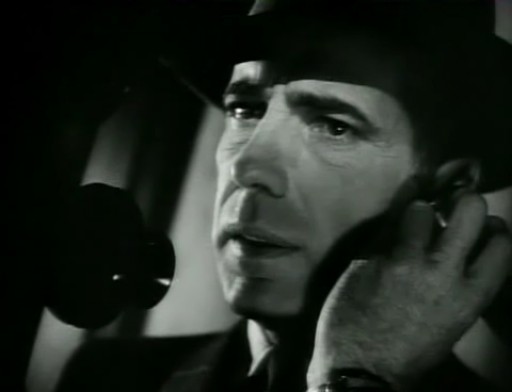
Conflict (1945, USA, Bernhardt) - Humphrey Bogart

Conflict (1945, USA, Bernhardt) – Humphrey Bogart has psychological hang-ups, which he decides to resolve by murdering his wife.  That doesn’t really help.  Watched it all.

Rhapsody in Blue (1945, USA, Rapper) – George Gershwin was a kid once too, and faced adversity etc.  Watched: 8 minutes.

Bud Abbott and Lou Costello in Hollywood (1945, USA, Simon) – This isn’t funny.  Famous comedians have been a disappointment in this marathon.  The Marx Brothers are fantastic, of course, but then .. nothing.  I’ve hated Chaplin, Lloyd, Keaton, The Three Stooges,  Laurel and Hardy, and now Abbott and Costello.  I guess comedians just weren’t all that funny back then.  Watched 9 minutes.

Favorite books of 2010

With everybody making lists of their favorite books of 2009, here are my favorite books of 2010:

The Wheel of Time by Robert Jordan, abridged edition, 800 pages.  Half the cuts were achieved by removing all references to braid-tugging (whatever that is).

Supercalifragilisticexpialidociousconomics by Steven D. Levitt and Stephen J. Dubner, in which we learn that if you approach it as a sort of game, even cleaning your room can be fun.  We also follow a rogue sociologist’s initiation into the suprisingly jolly life of chimney sweeps.

On Getting a Grip by Aristotle.  Previously thought lost, this rediscovered appendix to the Nicomachean Ethics argues that people should just calm the fuck down and quit whining, because it’s not the end of the world.  It becomes the best-selling book of the year, and a whole world leaves 2010 with the ability to not be such stupid assholes all the time.

Yes We Did It All by Anonymous.  In this tell-all memoir by a former member of the secret world government, we learn how NWO and the Bilderberg Group killed the Kennedys, faked the moon-landing, blew up the World Trade Center, and ruined the Star Wars prequels.

Zombies Are Totally Awesome.  In this brain-splattering retelling of World War II, zombie Roosevelt, zombie Churchill and zombie Stalin join forces against zombie Hitler, zombie Mussolini and zombie Hello Kitty.  In the apocalyptic climax, G. I. zombies and zombie Comrades fight their way through the last line of Nazi zombies, only to find that zombie Hitler has already eaten his own brain.

But he had been brought up to believe that honest citizens had nothing to fear

I’m reading all of Heinlein’s books, chronologically.  Slowly, a couple a year, because wouldn’t it be horrible to find that there weren’t any more left?  I do the same with Terry Pratchett.  There’s no hurry.  I don’t plan to die soon.

Now I’m at Between Planets from 1951.  It’s a variation over a theme Heinlein used often: The American Revolution, with emphasis on the second word.  Heinlein didn’t believe nations were Eternally Great because of something someone wrote in a constitution centuries ago.  Any state, no matter how well it started out, might eventually deteriorate into an oppressive police state.

And then you’d have to start a revolution all over again.  Which is where the Heinlein protagonist usually enters the picture.  On the verge to being ready to chase the diseased, remote, authoritarian state off his land.  All he needs is one final outrage to push him over the edge.

Heinlein’s message to the teenagers his early books were written for, was: Question all authority – including your teachers.  Make up your own mind.  That was subversive in 1951, and it still is.  His strong anti-racist message isn’t, but the way it’s presented remains fresh and un-p.c today.

The plot of Between Planets is basically just a series of fortunate accidents.  Come to think of it, most of Heinlein’s novels were.  But he was often better at hiding it.

40’s movies marathon – part 59

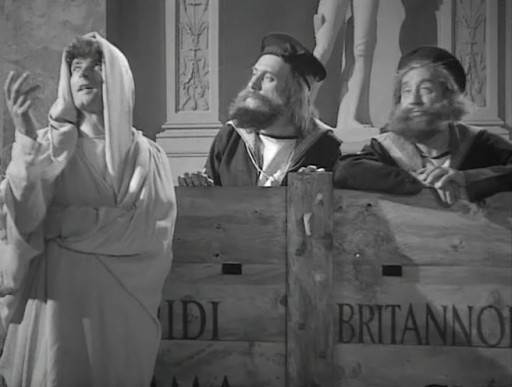
Fiddlers Three (1944, UK, Watt) – Two Ealing chaps get sent back into Roman times.  Very silly.  Favorite line: “Another government housing scheme gone wrong”, said while looking at Stonehenge.  Favorite scene: Speaking pig-latin to hide their meaning from their Roman captors.  No, wait, my favorite is the messenger who tries to deliver his news in a grand oratory style but keeps getting thrown out.  Watched it all.

Nabonga (1944, USA, Newfield) – A girl and her trigger-happy father crashes in jungle, befriends gorilla.  Bad in every way.  Watched: 10 minutes.

The Three Caballeros (1944, USA, Ferguson) – This isn’t a good Disney movie, but I love seeing them experiment.  It looks like they had fun making this, thinking up visual gags and new ways to present what’s really a subject with limited potential: South America.  Watched it all.

Going My Way (1944, USA, McCarey) – A new priest arrives in a neighbourhood, and must deal with loan sharks, nasty old ladies and atheists.  Watched: 8 minutes.

Mademoiselle Fifi (1944, USA, Wise) – Stagecouch, Franco-Prussian war edition.  Turns out the Germans were Nazis even back then.  And, like today, (er, I mean 1944), most Frenchmen would rather deal with them than resist.  Watched it all.  Starring Simone Simon as General de Gaulle, who by making a symbolic contribution makes it all seem okay in the end.

We’re encouraging amateur terrorism

Islamist terrorist groups should have realized by now that there are two ways to execute a terrorist attack against a Western country.

1) Spend time, resources and trained terrorists on a spectacular attack that kills a lot of people.

2) Put some amateur on a plane and have him set fire to his leg.

From a terrorist point of view, the first option achieves the most.  Whether the goal is to spread fear or cause the enemy to respond in a clumsy and oppressive manner, a successful attack is better than a failed one.

But it’s also a lot more expensive.  Considering how cheap the second alternative is, the pay-off is huge.  You don’t have to train the terrorist.  You don’t have to think of a fool-proof plan, just a plausible one.

And what you get in return is a lot of fear, a lot of press coverage, and a lot of stupid security responses.

Option 2 works better in certain environments.  A failed terrorist attack against a plane is scarier than a failed terrorist attack against a bus or the subway.  And there’s far more governments can (pretend to) do about it, adding to the paranoia.

Which means we may actually be providing terrorist organizations with an incentive to carry out lots of stupid, failed attacks on airplanes. This does have an upside, (maybe they won’t bother with real attacks), but it’s mostly just very stupid.

We need to learn how to live with terrorism.  This isn’t it.

Romjulsbrettspill for voksne: Agricola

Agricola ble ingen suksess i romjula.  Bl.a. fordi reglene tar en evighet å forklare – og det er bare “familieversjonen”: Standardreglene kompliseres av hundrevis av kort man kan spille underveis.  Man bør helst spille gjennom dette en gang eller to før man kjenner spillet godt nok til å legge en god plan for å vinne.  Agricola er altså et spill for de mer dedikerte brettspillerne.

Og det er jo jeg, så jeg liker dette godt.

Agricola simulerer gårdsdrift, og metaforen er uvanlig godt gjennomført.  Dette er et spill hvor du pløyer jord, kjøper såkorn, sår, høster, baker, avler dyr, – og får barn.  Og alt dette er bygget inn i spillmekanismen på en helt naturlig måte.  Jeg er imponert over hvor gjennomtenkt spilldesignet er.

Agricola spilles over få runder, med et begrenset antall handlinger til rådighet hver runde.  Siden hver handling bare kan utføres av én spiller i hver runde, (f.eks. “pløy et nytt jorde på gården din”), er spillerne gjerne nødt til å finne hver sine vinnerstrategier.

Spennende.  Men ikke helt riktig for denne forsamlingen.

Og dermed er romjula snart over, men i tilfelle du skulle befinne deg sammen med venner eller familie på andre tider av året også, anbefaler jeg en kikk på Sequence, Bandu og Pandemic.  Alle gode spill på hver sin måte, og alle enkle å komme i gang med.

Lov meg uansett én ting: Slutt å kjøpe brettspill i bokhandelen.  Også om det er til barn.  Kjøp dem på spillskrinet.no eller brettspill.no.