Hey look – I bought a Microsoft product

I bought a Microsoft product.  I don’t think I’ve ever actually bought a Microsoft product before.  It’s not because I don’t use Microsoft products.  I’ve been using their OS’es for close to two decades.  At work I write my code with Microsoft developer tools, for use in close integration with the Microsoft Office platform.

But, apart from some games, I’ve never personally bought a piece of Microsoft software.  It came with the PC, or my employer paid for it.

The product is OneNote 2010, which is sort of a scratchpad solution, a “note pad” if you will.  I bought it because I use it a lot at work, and I found myself missing it when I was writing at home.

OneNote is a fantastic product.  Actually the whole Office platform is.  I don’t think people quite appreciate what a leap in user-friendliness the Office suite has been through in the 2007 and 2010 versions.  It’s almost so I wish Apple would hire Microsoft’s Office team to rewrite iTunes.  You know, to make using it not remind you of a Kafka novel.  Maybe I’ll e-mail Jobs.  See what he thinks.

But OneNote is the only Office product I would ever use at home.  Word is for Documents, something I sometimes must produce at work.  Nobody outside a business environment ever asked for a Document.  Same with PowerPoint and Excel.

But OneNote: A giant blank piece of paper that is just sitting there, waiting for you to scribble a note or paste some info or start an essay.  Beautiful.

Om å ikke føle seg hjemme på bokfestival

Det var bokfestival i Oslo i helgen, og utifra programmet å dømme handlet det for det meste om at den norske bokbransjen hyllet seg selv og sine.  Slik er det ofte med kultur i Norge.  Du har mektige bransjeaktører, med tette bånd til stat og medier, og et høytidelig selvbilde.  Disse folka driver ikke med hvasomhelst, de leverer Kultur.

Som fanatisk bokelsker er dette for meg litt som å komme inn i en fremmed verden.  En verden hvor man riktignok snakker om bøker, og skriver bøker, og opphever Boken til det høyeste i vårt samfunn, men hvor jeg får følelsen av at man mener noe annet med “bok” enn jeg gjør.  At det er noe som ikke stemmer.

For jeg tror ikke norsk litteratur er god nok til å fortjene dette selvbildet.  Jeg sier ikke at alt er dårlig, men at det er noe galt med selve bransjen, noe uærlig med måten den driver på, med sine tette bånd til kulturpolitikere og kulturelite.  Man leverer kvantitet, ikke kvalitet, og tror man dermed bygger en kulturnasjon.

Det som plager meg er dette: Hvis det virkelig finnes noen store talenter blant unge norske forfattere, hvorfor gjør de ikke opprør mot bransjen og kulturdepartementet?  Ser de ikke selvmotsigelsen i å være en snill og lydig statsfinansiert forfatter?

Dvs., jeg forstår jo hvorfor: Det er der alle pengene er.  Man vil jo leve av dette.  Og slik videreføres sykdommen til neste generasjon.

Consider the care with which salmon are harvested in the best aquaculture operations

There are several common ways of harvesting fish from the wild, none of them ideal. In the most controlled and least efficient method, a few fishermen catch a few fish, ice them immediately, and deliver them to shore within hours. This method can produce very fresh and high-quality fish – if they are caught quickly with minimal struggle, expertly killed and cleaned, quickly and thoroughly iced, and promptly delivered to market. But if the fish are exhausted, processing is less than ideal, or cold storage is interrupted, qualify will suffer.

[..]

By contrast to the logistical challenges posed by fishing, consider the care with which salmon are harvested in the best aquaculture operations. First, the fish are starved for seven to ten days to reduce the levels of bacteria and digestive enzymes in the gut that may otherwise accelerate spoilage. The fish are anesthetized in chilled water saturated with carbon dioxide, then killed either with a blow to the head or by bleeding with a cut through the blood vessels of the gill and tail.  Because the blood contains both enzymes and reactive hemoglobin iron, bleeding improves the fish’s flavor, texture, color and market life. Workers then clean the fish while it’s still cold, and may wrap it in plastic to protect it from direct contact with ice or air.

– Harold McGee, On Food and Cooking

Trying to be ignorant about different things than everyone else

Head stuck in sand

I think we need more diversity in our ignorance.  It seems that, outside what we work with, we all know and don’t know pretty much the same things.  Some know more than others, but they know more of the same things.  We’re creating huge blind spots that almost nobody pays attention to.

This is something I think a lot about.  I’m obsessed with what is happening or has happened that we’re not paying attention to, simply because it’s not part of what everyone thinks is relevant right now, is not on the Unofficial List of Relevant Things.

Part of the problem is that once something enters that list, anyone who wants to be knowledgeable feels obligated to pay attention to it.  And there’s so much on the list that you don’t have time for anything else.  So the more we try to become “knowledgeable”, the more homogenous we become.

There’s a Sherlock Holmes story where we learn that Holmes doesn’t know that the Earth revolves around the Sun, because that’s not the kind of fact he wants to fill his head with.  His psychology is unsound, because the brain doesn’t really run out of storage space, but he’s basically correct, because we do run out of the time it takes us to learn these facts.

So I’m rebelling against those shared blind spots.  And I can only do it by deliberately being ignorant about different things than everyone else, things many believe that everyone should know.  There’s no other path to true diversity.

Claymore

Year: 2007

Type: Fantasy

Subtype: Half-demon girl warriors protect humanity from regular demons and former half-demons turned super-demons.  (Basically what I mean is there’s lots and lots of demons.)

Primary audience: Fight-scene aficionados, and people who miss Buffy but can do without the cheerful banter.

Tics: None worth mentioning.

Worth watching: Yes.

The secret organization that fuses traumatized demon victims with demon flesh to create an army of demon-fighting super warriors, Claymores, is actually a bit evil.  Such organizations usually are.  The demons are eviller, though, and the super-demons, former Claymores who have turned to the dark side, are the evillest of them all.  This creates for us a nice progression of baddies to introduce gradually throughout the series.  Claymore is a game of “how many times can we up the ante and still keep the fight scenes spectacularly entertaining?”  The answer is: Every time.  Every single time.

The story falls dead along the way, but the fight scenes inflate like the 1920’s Deutschmark, and I mean that in a good way.  There’s really nothing to do but gape at the wheelbarrows.  The violence here is a thing of beauty. It’s like every episode is a season finale of Buffy.  And that’s all I ask from any (mindless revenge-themed demon-fighting) series.

40’s movies marathon – part 123

Kind Hearts and Coronets (1949, UK, Hamer)

Twelve D’Ascoyne’s stand in line between Dennis Price and the dukedom he believes is his birthright.  They’re all played by that asshole Alec Guinness, so that makes it okay when he starts bumping them off, one by one.  Watched it all.  Watching these early Guinness movies makes me wonder what Star Wars would have been like if he’d played Obi-Wan Kenobi as a really creepy, mean old man.

Sands of Iwo Jima (1949, USA, Dwan)

Only four years after the war, and already there’s a streak of insincerity in the war movies.  The characters are just a little bit less real, and more like stock characters.  Basically, they’re less Robert Mitchum, and more John Wayne.  Watched: 9 minutes.

On the Town (1949, USA)

Hey, lonely sailor!  Come to New York, where you’ll meet girls in no time, even if you look like Frank Sinatra!  Watched it all. It seems that Betty Comden and Adolph Green were involved with everything I think of as Real Musicals.  They took the whole corny “hey let’s break out into song” trick and made it just the right amount of self-aware.  But this isn’t one of my Comden&Green favorites.

The Bridge(?) (1949, China)

“Quickly rob to live, warm waters all grew a Chinese foot of half”?  “The bridge shelf sees and then take not to live”??!  I knew Communist Party rhetoric could be dense, but in this case I suspect the problem is the translation.  Watched: 3 minutes.

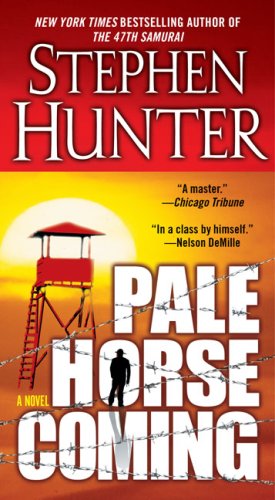
Stephen Hunter – Pale Horse Coming

Stephen Hunter - Pale Horse Coming

There’s usually a government conspiracy at the bottom in Stephen Hunter’s novels.  He’s that kind of thriller writer.  The conspiracies sometimes stretch over generations, something Hunter can pull off because the two main characters in his universe are father and son Swagger, shooting it out with the powers that be in their respective eras: The post-war years and the 1990’s present.  One novel had a timeline in Vietnam as well, making it three separate eras where the strings are pulled by the (same) men in black.  Now that’s a powerful conspiracy.

And then these badass Swagger characters come in and shoot it all up.  That’s so much fun.  I’ve described Hunter’s novels earlier as trash, and they are, in the positive sense of easily readable palate cleansers.  I don’t mean that they’re unimaginative.  That doesn’t work for me.  What I mean is that he’s found a sweet spot in the balance between being readable and being interesting.

So whenever I want to remind myself of why I love to read, I pick up a Stephen Hunter novel, and gobble it down like back when I had just discovered books and could think of nothing more wonderful than spending an evening in a chair reading some amazing adventure story.  And then I forget the story and move on.  But the experience – so much fun!

Oh, and the story: A 1950’s Mississippi penal colony for blacks is a modern heart of darkness.  There’s a conspiracy.  And lots of shooting and general badassery.

William Manchester – The Glory and the Dream

Out here in one of the American satellite cultures, the events that took place in the United States in the half-century between the 1930’s and the 1970’s are at least as much our history as those that actually took place in our own country.  Some Norwegians feel ambivalent about this, but it would be hard to deny it.

William Manchester’s The Glory and the Dream covers this period in American history.  Published in 1975, it’s a subjective history, full of opinions – and the occasional historical myth.  The book not only observes this period, but is a product of it.  It’s a point of view.  I find that kind of historical writing really refreshing.  Later historians get more of the facts right, but there’s no substitute for the voices of the people who lived through it all.  Manchester falls somewhere between these roles.  This is not his personal story, but it is his personal history.

This is a massive book, 1400 pages, which is why I read it as a high-speed audiobook.  “Slow readers” do so at their peril.  (I guess there’s also a case to be made here for ebooks.)

But I’m not sure what could have been left out.  Manchester zooms in and out, from broad strokes to detailed accounts of interesting events.  He covers all the important events you can remember, putting them in perspective, which is what this sort of history is for.

And let me also remind you again of Rick Perlstein’s Nixonland, which covers some of the same period.

40′s movies marathon – part 122

The Fountainhead (1949, USA, Vidor)

Now, I dislike Ayn Rand, her books, and her followers, and that includes you, all your friends, your children, and your children’s children to the seventh generation, etc. etc., (in a half-friendly family squabble sort of way), but it has to be said that this is the most intellectually interesting movie of the entire decade.  And it is an inspiring fable.  Rand’s insanities aside, her ideas here about the unshakable integrity of the individual, and what it means to take responsibility for your choices, are close to what I try to live by.  Perhaps you need to be delusional to empathize with Roark.  Perhaps I am.  Watched it all.

Samson and Delilah (1949, USA, DeMille)

Behold – a new age of Biblical epics is upon us!  As you may recall from Sunday school, Samson was the great warrior in the Book of Judges who introduced the principles of LIBERTY and FREEDOM to the DECADENT (ie. bikini-wearing) world of 1000 B.C.  Watched: 12 minutes.  I think these movies get better later.  Right?  And less campy?  At least I remember seeing one or two good ones.

Lust for Gold (1949, USA, Simon)

A legendary hidden gold mine in the mountain has attracted adventurers and murderers for generations.  They usually meet bad ends.  The plot here is unusually complex for a movie.  It shifts between two different centuries, and manages to be just as interesting in both of them.  Watched it all.