The Pillars of the Earth

Year: 2010

Type: Historical

Subtype: Could all the nobles who are fighting over this shitty little kingdom please quiet down a bit, we’re trying to build something over here?

Primary audience: People who want to find out if folks in the dark ages talked, behaved and had sex just like we do. (They did.)

Tics: Witch hunts, Ian McShane and other anachronisms.

Worth watching: Yes.

There’s little to live for in England in the 12th century, unless you can take part in one of the four worthwhile pursuits of the age: Scheming, murdering, incest and witchcraft.  And possibly cathedral building, if you’re up to it.  It’ll take you a couple of lifetimes.  And you’ll have to contend with a class of nobles to whom chivalry and the Peace and Truce of God movement are just some fancy schmancy continental innovations.  But at least you’re not a peasant or cannon fodder like everyone else.

You don’t get a sense that religion matters much to these people.  Everyone feels like secular people who have occasional flashes of religious feeling.  But nobody watches this for the history, right?  And it’s actually those few religious moments that separate this from Rome-me-too’s like The Tudors: The work on the cathedral.  The fake relic.  Or that brilliant scene where the monks intimidate the workers of a quarry to give them the stones they are entitled to.

And then all the enjoyable-annoying Ian McShane Deadwood shenanigans fade away, and reveal something beautiful: A story about the joy of building.

Listened to last week: Bad Religion

I’ve been on a Bad Religion binge recently.  I’ve never heard them before.  It pisses me off a little, because this is fantastic.  I’m getting all sorts of “recommendations” from the music software I use, iTunes and last.fm, but they are never any good.  Never.  They’re more like “hey, you just listened to something from subgenre X, here’s some more recent music from that genre, which is all derivative of that one good band you like, but don’t blame us, you’re the one who apparently likes this crap”.  What I want is: “OMG you’ve missed out on Bad Religion?!  There’s a hole in your mind!”

Bad Religion – Portrait of Authority, from the 1993 album Recipe for Hate

Bad Religion – The Answer, from the 1992 album Generator

Bad Religion – 21st Century Digital Boy, from the 1990 album Against the Grain

Bad Religion – I Want to Conquer the World, from the 1989 album No Control

40’s movies marathon – part 121

Gategutter / Boys from the Streets (1949, Norway, Skouen)

There are no easy paths through life for working class kids in 1920’s Oslo.  Crime is fun but dangerous.  Honest labor feels better, but you’re exploited by the middle class.  And Communism is appealing but also a bit scary.  What’s the point of revolution when all you want is a steady job?  Perhaps the answer is some sort of non-Communist Labor movement?  Watched it all.  I didn’t know there were Norwegian neo-realist movies, but this one fits right in with what the Italians were doing at the time.

Tight Little Island (1949, UK, Mackendrick)

Whiskey runs out on a Scottish island, oh no!  War is hell!  But maybe they could think of some desperate plan to get hold of some!  Watched: 17 minutes.  An entire community ravaged by alcoholism is no longer one of those inherently mirthful concepts, I guess.

Rope of Sand (1949, USA, Dieterle)

Burt Lancaster doesn’t care about recovering the diamonds he has hidden in the desert.  He just wants to get revenge on the cop who once tortured him for no reason.  Watched it all.  I think this marks the point when South Africa takes over from Nazi Germany the role as the world’s creepy Aryan assholes.

Not Wanted (1949, USA, Lupino)

Peggy Olson gets pregnant with some loser from work, and has to give the baby away.  It’s the madhouse next for her!  Watched: 19 minutes.

Two hundred billion hours

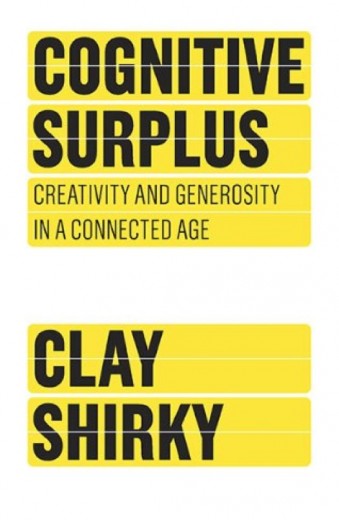
Clay Shirky - Cognitive Surplus

Like with many books, there’s a great essay hiding within the 200 pages of Clay Shirky’s Cognitive Surplus.  You can read it here, or watch it as a presentation.  It’s about how television was the gin of the post-war decades, a way to make life with an abundance of spare time more endurable, but now the internet allows us to spend that time in ways that are much more useful and/or fun.

Clay Shirky and Nicholas Carr are sort of mini-nemesises.  They throw little darts at each other in their books. I love that, because I’m a fan of both.  This new conversation on what the internet is doing to us is the most interesting one going on at the moment.  Shirky says the internet is liberating our spare time.  Carr responds that we’re actually watching more TV than ever.  Well, but Shirky is really talking about a potential, which is amazing even if still unrealized.  And so on.

So much for the essay, which is more or less the first chapter of the book.  The rest is .. the usual feel-good stuff about what nice thing some people did with social media once, and look at this Open Source thing, is that amazing or what?  It’s not wrong, it’s just old, and hastily thrown together.  Shirky is showing signs of being stuck in the 00’s.  I say we should take the decade’s good ideas with us, and move on.

But read the essay, definitely.  Go read it right now, there’s nothing more to see here.

Forget the future: What is happening right now that we need to be aware of, but aren’t?

Nobody does predictions any more, they do “scenarios”, but I suspect that trying to guess anything at all about the future may be worthless.

Imagine that in the world 20 years from now, there is a new and important factor.  Perhaps a technological factor, or something cultural or political.  Anything.  And that this is a factor that doesn’t exist today.  It should be easy to think of such factors in our own world that didn’t exist 20 years ago.

What can you possibly hope to say about that future world without understanding that factor? Very little.

What we should be looking for today instead is things that already have happened, or are happening right now, that we haven’t discovered or fully understood yet.

Think of the financial crisis, back before anyone knew about it.  There was a big crisis in the future, but if enough people had discovered it earlier, there would have been a smaller crisis in the present.  A 2007 “scenario” about the future of the world economy would have been worthless.  What we needed was someone to say “there’s something going on here that we all need to pay attention to.”

Even correct statement about the future are probably more useful when rephrased as statements about the present.  “Future workers will behave like this!” vs “today’s children have such and such characteristics”.

What is happening right now that we need to be aware of, but aren’t?  Stop trying to extrapolate from your current knowledge.  Open your eyes.  Pay attention.  Tell us what you see.

A little bout with black magic

It pains me to report that eventually my mother’s dabblings led her into a little bout with black magic. I wish I could deny this and prevent many of her descendants from being burned at the stake, but unfortunately she not only wrote and signed a small treatise on the subject under the influence of a sinister buffoon called Aleister Crowley, but she is also mentioned either under her true name or under an alias in all books about this rancid character.

At just about the time I was becoming acclimated to the Ecoles des Roches in Normandy, quite unaware, as usual, of what Mother was up to, Mother was in London acclimating herself to Aleister Crowley.

The practitioner and staunch defender of every form of vice historically known to man, generally accepted as one of the most depraved, vicious, and revolting humbugs who ever escaped from a nightmare or a lunatic asylum, universally despised and enthusiastically expelled from every country he ever tried to live in, Mr. Crowley nevertheless was considered by my mother to be not only the epitome of charm and good manners, but also the possessor of one of the very few genius-bathed brains she had been privileged to observe at work during her entire lifetime.  Ask me not why!  Much as I revered her, my mother was still a woman, one of that wondrous gender whose thought processes are not for male understanding.

– Preston Sturges, Preston Sturges

40’s movies marathon – best of 1948

Well, that was 1948.  A year of slow but noticable change in the movie industry, and of change in this marathon, where I learned how to upload clips of the scences I can’t or don’t want to forget.  You can also find the clips on YouTube, and that may actually be more interesting than these reviews, because is there anything more pointless than reading about movies?  I try to make clips that represent what I liked about the movie, so if you like the clip, you’ll probably like the movie.

Best of the best

Rope

The Red Shoes

Literary classics

Macbeth

Hamlet

Oliver Twist

Meanwhile, in the former Axis

Germania Anno Zero

The Bicycle Thief

A Hen in the Wind

A Foreign Affair

Drunken Angel

Angry murdering murderers and the murdering murderers who murder them

Raw Deal

The Man From Colorado

Key Largo

Act of Violence

Red River

The Treasure of Sierra Madre

Road House

Disney at their worst

Melody Time

So Dear to My Heart

Preston Sturges at his worst

Unfaithfully Yours

I can’t think of more categories

Daughter of Darkness

Louisiana Story

Krakatit

Organize your work like a programmer

In my essay on how software is made, I mentioned how programmers are constantly trying to find smarter, more flexible ways to Get Things Done.  This involves adopting all kinds of fads, and then some fads turn out to be really good ideas, and become permanent.

An interesting fad in my world at the moment is called Kanban.  One core idea is about how you visualize and restrict your team’s workflow in order to highlight bottlenecks, and maintain a steady flow of tasks without getting distracted by doing ten things at once.

What you do is make a board with different stages a task can go through.  For each area you choose a limit for how many tasks can be there at a time.  And then you use post-it notes to mark where each task is. Every time a task is moved, that opens up space for another task from upstream.  Essentially tasks are pulled instead of pushed through the system.

For instance, you may have a Backlog area for future work (max: unlimited? four months worth?), a Ready area for tasks you are ready to start on next (max: 5?), an In Progress area for the tasks you work on right now (max: 2?), and an Approval area for finished tasks that somebody needs to verify, (max: 5?)  The areas and limits are up to you.

Here’s one version of such a board.  Here’s another:

This might be useful in all kinds of situations, also for individuals.  Try it for your own work, see if it works.

Ergo Proxy

Year: 2006

Type: Science fiction

Subtype: Shining dystopia on a hill, with monster gods and androids on the verge of self-awareness.

Primary audience: People who think it’s quite okay that many things sound like Coldplay now.

Tics: Hey look how much I remember from philosophy class!

Worth watching: Yes.

The earth is formless and void, except for a great domed city run along the principle of “life is hard, let’s go shopping!”  Outside there’s only the wind and the cold, dead rock.  Inside there is dull perfection.  Androids do all the work, a junta all the thinking.  A secret race of monsters do something as well, but it’s not quite clear what.  A bit of murdering, a bit of mystery.  A bit of bringing the story outside the dome, where madmen and even more monsters hide in ruined neighbor cities.

There ought to be a law against filling your stories with philosophical references and hints of metaphysical relevance.  Or maybe a fine.  It’s the old The Prisoner sickness, where the ambitions of the Magnificent Creator spin out of control, towards a like-a-significant ending about existence and narrative etc.

But that’s only the end.  The feet of this series stay mostly close to the ground.  I like the characters, the mood, the visuals, the music.  I even liked the nonsensical standalone episode that spoofs Walt Disney. Balanced against all that, pompousness is a price worth paying.

40’s movies marathon – part 120

The Treasure of Sierra Madre (1948) - Humphrey Bogart, Walter Huston, Tim Holt

The Treasure of Sierra Madre (1948, USA, Huston)

Being poor doesn’t make you a better person.  It makes you greedy and mean and paranoid, and desperate to hold on to any wealth that may come your way.  Well, or maybe that’s just Humphrey Bogart, whose latent psychotic tendencies are triggered by the sight or thought or even smell of GOLD, GOLD I tell you, the hills are full of GOLD, and it’s all mine!!!!!  Watched it all.

.. and so we enter .. 1949!

House of Strangers (1949, USA, Mankiewicz)

You can put a moustache on Edward G. Robinson and teach him to talk like Chico Marx, but that still doesn’t make him a believable Italian-American.  And it’s a shame too, because this looked pretty good until he showed up.  Watched: 20 minutes.

Reign of Terror (1949, USA, Mann)

Trust Anthony Mann to make the most out of a low budget, and bring out the Reign of Terror not the way it actually happened, but the way it appears in our nightmares, a time of blood and chaos and fanaticism.  Watched it all.

The Red Menace (1949, USA, Springsteen)

The Communist Party has tentacles all over America, and every time they manage to seduce and ensnare another disaffected veteran, a Party boss in some secret Party lair strokes his Party cat and goes muwhahahaha.   Watched: 14 minutes.  I kind of look forward to seeing some genuine red scare movies now.  Maybe there are even a few good ones?