Bård Larsen – Idealistene

Bård Larsen - Idealistene, Den norske venstresidens reise i det autoritære

Min relativt partiske anmeldelse av Bård Larsens relativt partiske bok om diktatorflørten på ytre venstre, Idealistene, kan du nå lese hos Humanist.

Etter noen tiår med jevnlige oppgjør med 70-tallets røde synder, er de gamle synderne lei av å bli spurt om de angrer, og vi tilskuere finner det ikke så lett å finne entusiasmen vi heller. Selv på den rampete høyresiden føler vel mange at moroa har gått ut av skadefryden.

Bård Larsens Idealistene. Den norske venstresidens reise i det autoritære kommer derfor på litt feil tidspunkt, men det er den riktige boken, og den tilfører noe nytt: Et bredere fokus, ut over AKP(ml) og over i SVs og AUFs rekker, fra 70-tallet og fram til i dag. I stedet for nye historier om ml’ernes absurde eventyr, handler Idealistene om den radikale venstresiden i helhet.
Les resten her.

1950s movies marathon – Best of 1953

Compared to 1952, 1953 was an excellent year for movies. Some of them were even in widescreen and stereo, technologies one starts to miss after watching little but old movies for a couple of years.

Revenge of the nerds

The War of the Worlds

The Beast from 20,000 Fathoms

House of Wax 

Sadko 

Dangerous youths

The Wild One  

I Vinti

The 5,000 Fingers of Dr T 

Summer with Monika 

Dangerous adults

Pickup on South Street 

The Wages of Fear 

The Naked Spur 

Mr. Hulot’s Holiday

Ladies and “ladies”

Gentlemen Prefer Blondes

Calamity Jane 

Glen or Glenda

Top of the world, ma

The Conquest of Everest

Julius Caesar 

.. and best of the best, also uncategorizable: 

Stalag 17

Next up: 1954, with 414 movies begging for attention, which may make you wonder how much time I actually spend on this marathon.  Surprisingly little, but it helps not to have a TV.

Book roundup: Evgeny Morozov, Frank Rossavik

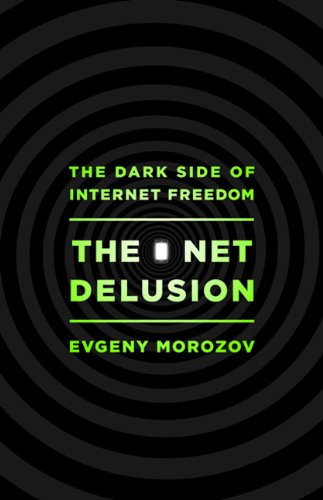
Evgeny Morozov - The Net Delusion (2011)

Evgeny MorozovThe Net Delusion (2011)

The entire vocabulary of Western cyber-utopians, from “Twitter revolutions” to “the Great Firewall of China” is the product of a mythology that has no connection with the role technology actually plays in modern dictatorships, which have found diverse and clever ways to use technology to their advantage.  Iranians aren’t on Twitter, internet access is often more a safety valve than a foothold for freedom, and your local security police would like you to reveal your social network on Facebook thank you very much.

Recommended: Yes.  Morozov makes the same point, but in a more rational way, as Adam Curtis in All Watched Over..: Cyber-utopianism is worse than useless, it actively benefits the true power holders in a society.

Frank Rossavik – SV, Fra Kings Bay til Kongens bord (2011)

The rise and eventual taming of Norway’s Socialist Left Party.  A good history uses its subject as a lens to see its world through.  This one gets bogged down in names and dates, and has no vision, which is a shame, because whatever else you can say about SV’s tortured attempt at finding a third way between social democracy and communism, at least it was interesting, especially in its early newspaper incarnation.  This isn’t.

Read: 60 pages, + the apologetic chapter on their flirtation with Communist dictators, a story that can’t be told honestly without at least offending someone.  Rossavik seems unwilling to do that.

Recommended: No.

1950s movies marathon – part 46

The Naked Spur (1953, USA, Mann)

It’s a shame James Stewart made such a great good guy, the kind who’d see the upside of a nuclear holocaust, because he was even better when you weren’t sure if he’d shoot you or hug you or both.  Watched it all before, long ago, and again now.  The Naked Spur once awoke me to how good Westerns could be.  It still sets the standard, but the rest of the genre hasn’t live up to the promise.

Salome (1953, USA)

The Bible got it all wrong: Salome / Rita Hayworth was actually an early Christian who danced before Herod to save the life of John the Baptist.  Save it.  But for some reason he got beheaded instead.  Watched: 15 minutes, so I’m not sure what went wrong, but it seems to have had something to do with an evil stepmother.

Donovan’s Brain (1953, USA)

The dead millionaire’s evil brain is kept alive in a laboratory, and spends its time controlling the minds of nearby scientists and humming Metallica tunes.  Watched: 35 minutes.

I Confess (1953, USA, Hitchcock)

Another thing I didn’t expect about this movie marathon: How old-fashioned a typical Hitchcock thriller would feel by 1953.  This is basically a Columbo episode, with Karl Malden as Columbo.  Watched: 28 minutes.

..virtue often depends not on humility but on arrogance

Discussing a new book (The Lucifer Effect) by Philip Zimbardo, the social psychologist Professor Nussbaum ended on an upbeat note: “Let us hope that The Lucifer Effect, which confronts us with the worst in ourselves, stimulates a critical conversation that will lead to more sensible and less arrogant strategies for coping with our human weakness.”

I don’t quite know what “sensible and less arrogant strategies” might be, but I do know that while humility generates some virtues, there is also a vital connection between arrogance and virtue. Why is it that most people behave decently? No doubt in part because of the fact that they are decent and virtuous people. They may well also fear the consequences of bad conduct. “The passion to be reckoned on,” as Hobbes remarks, “is fear.” But one of the other main bases of virtue lies in the fact that people think, with a certain contempt and derision: “I wouldn’t do that evil (base, etc.) kind of thing. I am above such conduct.” Some moralists consider such moral arrogance as itself a vice. The ability to understand oneself in such moral terms, however – as a “lady” (rather than merely a woman), or as a “gentleman”, or even as an honest person, indeed even as being merely common or garden decent – commonly rests in part on feeling superior to others. In other words, virtue often depends not on humility but on arrogance.

– Kenneth Minogue, The Servile Mind (2010)

..each person thus becomes his own fantasy despot

It is a conspicous feature of democracy, as it evolves from generation to generation, that it leads people increasingly to take up public positions on the private affairs of others. Wherever people discover that money is being spent, either privately or by public officials, they commonly develop opinions on how it ought to be spent. In a state increasingly managed right down to small details of conduct, each person thus becomes his own fantasy despot, disposing of others and their resources as he or she thinks desirable. And this tendency itself results from another feature of the moral revolution. Democracy demands, or at least seems to demand, that its subjects should have opinions on most matters of public discussion. But public policy is a complicated matter and few intelligent comments can be made without a great deal of time being spent on the detail. On the other hand, every public policy may be judged in terms of its desirability. However ignorant a person may be, he or she can always  moralize. And it is the propensity to moralize that takes up most of the space for public discussion in contemporary democracy.

– Kenneth Minogue, The Servile Mind (2010)

1950s movies marathon – part 45

Calamity Jane (1953, USA)

Come sing along with the happy citizens of Deadwood, the colorfullest cheerfullest town of the good ol’ West!  Doris Day as Calamity Jane is one of the most astonishing things that have ever happened in movies.  She’s awful, and the movie is awful too, but it doesn’t matter, because this is a fantastic awful movie.  Watched it all.  This movie is only a few line changes away from being a lesbian love drama, but it ends with Calamity Jane marrying Wild Bill Hickock, destined for a long life of happiness.

Battle Circus (1953, USA)

Did you ever wonder what M.A.S.H. would look like if it wasn’t a comedy, and featured Humphrey Bogart as the scruffy doctor?  Well here it is!  It has the helicopters and tents and operation scenes and everything.  Even Hotlips!  Watched: 17 minutes.

Holiday with Angel / Dovolená s Andelem (1953, Czechoslovakia)

All the most productive workers of Czechoslovakia get rewarded by the Party with something called a “vacation”, a period of non-work in relaxing surroundings.   They’re sent off to a fancy hotel where most of the rooms even have running water!  In the future, such “vacations” will be available to all loyal workers in the socialist worker’s paradise.  Watched it all.

Will Any Gentleman..? (1953, UK)

Hey, this movie has two future Doctor Whos in it, Jon Pertwee and William Hartnell!  Nerdgasm!  The younger Pertwee would have made an excellent Doctor even by our current youth-fixated standards.  Watched: 14 minutes.

..sell all thou hast and give it to the poor

Self-hatred in the West is a strange and indeed puzzling thing. It seems to happen when loyalty to one’s own cultural heritage is transferred to an ideal location. A common explanation offers guilt as the psychological dynamic of cultural self-alienation, but it is not at all clear what the average European should feel guilty for, and who should be guilty for whatever it might turn out to be. Guilt in this context is seldom defined, but we may suggest, in brief, that feeling guilty is a learned emotion derived from a consciousness, real or imagined, that one has betrayed a moral principle constituting one’s identity. It might be possible, for example, that some people have so internalized equality of social and economic conditions as a moral principle that they experience the disabling emotion of guilt merely from the contrast between their own wealth, on the one hand, and the poverty of some reference group on the other. If so, the therapy is clear enough: Sell all thou hast and give it to the poor. Some individuals have in fact done this, but it is rare. If guilt does lie behind the passionate self-hatred of some Westerners, then they seem to have gritted their teeth and with great fortitude learned to enjoy its benefits.

– Kenneth Minogue, The Servile Mind (2010)

Sammen mot Schjenken, sammen om å ikke angre

Dagbladet er dømt til å betale erstatning til ambulansesjåfør Erik Schjenken, som de hengte ut som rasist i 2007. Uten å gå inn i detaljene om hva som skjedde i Sofienbergparken, virker det klart at sannheten langt i fra var så enkel som budskapet Dagbladet og andre medier presenterte: At to rasistiske ambulansesjåfører nektet en syk mann behandling fordi han hadde feil hudfarge.

Med andre ord gjorde pressen en dårlig jobb, på ambulansesjåførenes bekostning.

Jeg liker ikke at medier skal straffes for slurv.  Men snu på det: Hvilken beskyttelse har du som menneske når mediene i flokk beslutter at du skal henges ut?

I en sunn mediesituasjon ville du bli beskyttet av andre medier, på jakt etter sin egen vinkling på saken, og de mediene som hengte deg ut ville be om unskyldning når det viste seg etterpå at de hadde tatt feil.

Og det ville antagelig vært bra nok.  Ingen behov for erstatning.

Slik er det ikke.  Mediene står sammen om å henge deg ut, og de står sammen etterpå om å ikke angre på det.  Alle er kompis med alle, og de som innser at noen har gjort noe galt holder kjeft, eller avdramatiserer det.

Hvordan er pressen da forskjellig fra en bølle?  Og hvor ellers kan man gå enn til retten når den samfunnsinstitusjonen som skal belyse maktmisbruk har en blindsone for sine egne overgrep?  Det må være balanse i makten.  Når mediene ikke kan være kritiske ovenfor seg selv, hvor skal den balansen komme fra?

..freedom consists in the search for loopholes

A democratic assembly tends to understand legislation as a command addressed to the people. This accords, no doubt, with our common talk about “obeying the law”. We talk of laws “forbidding” certain kinds of conduct and “encouraging” others. Sometimes, indeed, laws are thought to be a signaling system, entities that “send a message.” Strictly speaking, however, these ways of thinking constitute a simpleminded misunderstanding of the rule of law. A command means an imperative addressed directly from a commander to an addressee, and the point of the command is extinguished with that situation or with that type of situation. A master of slaves commands his slaves. An employer can command an employee, within the limits of an agreed relationship of employment. ..

A law is something quite different. It is a hypothetical imperative, specifying a form of conduct that attracts certain sanctions should any particular instance of the conduct be defined as an offense by a court. The law does not “forbid” murder; it simply specifies a variety of penalties for a vriety of different kinds of killing. This view of law provides the formal sense in which living under law is what we in the West understand as freedom, and the point is thus very far from being a piece of legal pedantry. The creativity of Western societies in part results from pursuing one’s interests by finding lines of conduct that do not incur the sanctions of law. From a hostile point of view, freedom consists in the search for “loopholes”.

– Kenneth Minogue, The Servile Mind (2010)