40’s movies marathon – best of 1949

What an awful year in movies that was, especially for Hollywood, but the ‘49 movies that are good, are real good, and unique in a way earlier movies weren’t.  The end of the “golden age” was the end of one size fits all movies, and the beginning of “let’s try anything that could possibly draw some viewers away from television”.

Working class heroes

Thieves’ Highway

Give Us This Day

Libertarian rabblerousers

The Fountainhead

Passport to Pimlico

Old violence with a new edge

White Heat

Reign of Terror

Lust for Gold

Tension

Neo-realists can make okay movies too

Gategutter / Boys From the Streets

War, death and other humorous subjects

I Was a Male War Bride

The Barkleys of Broadway

Kind Hearts and Coronets

The Beautiful Blonde From Bashful Bend

Mr Belvedere Goes to College

Stalin extravaganza

The Fall of Berlin

Quiet intensity

Stray Dog

A Letter to Three Wives

The Small Back Room

The Third Man

The Quiet Duel

Rotation

Nudge psychology: Authoritarianism in prettier clothes

There’s a lot of interesting psychological research about how the choices we make are influenced by the way the situation is framed for us.  We’re not rational decision makers.  We take shortcuts that approximate reason, but actually isn’t.

There are two lessons you can take from this.  One is: This can help me learn to make better decisions.

Another is: Hey, I can use this to manipulate people!

Naturally, the second lesson appeals to politicians and other people who carry the blueprint of a perfect society in their hearts.  Cass Sunstein and Richard Thaler believe that “nudging”, improving people by presenting their choices differently, enables smarter, less intrusive social policies.  Libertarian paternalism.

It sounds harmless.  And it’s really clever.  But I agree with Brendan O’Neill at Spiked Online: These ideas are repulsive.

It’s okay to try to change people.  But the right way of doing that is by helping them become more aware their own choices, not tricking them into making the “right” ones.

Research on choice can be a force for good.  It can be used to show that you have more choices than you realize.  It can be used to shine a light on the shortcuts we take that sometimes lead to bad decisions.  I know it has helped me become conscious of my own decision making process in a way I wasn’t before.

But that requires a bit of trust in people, some genuine respect for personal freedom.  The courage to say: Here’s how your brain works.  The rest is up to you.

40′s movies marathon – part 134 (of 134!)

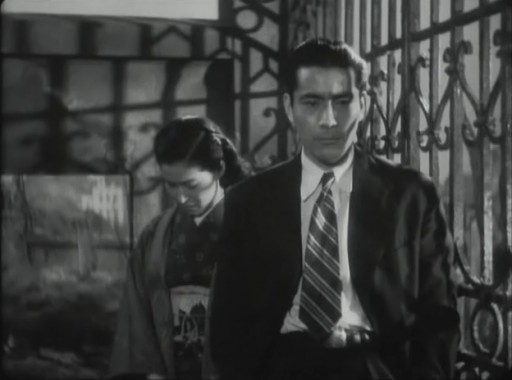
The Quiet Duel (1949, Kurosawa) - Toshirô Mifune

The Quiet Duel (1949, Japan, Kurosawa)

Again Kurosawa uses disease as a theme.  This time it’s syphilis, which the men carry home from the war, and are unable to cure.  And the women suffer their own permanent consequences from wartime accidents.  There’s no easy return to normalcy.  Something good that once existed is irrevocably lost.   But it’s still up to everyone how to deal with this loss: As honorable or dishonorable people.  Watched it all.

Intruder in the Dust (1949, USA, Brown)

Hollywood continues to discover racial discrimination.  Once again the main characters are all white, because, come on, you have to draw the line somewhere.  Watched: 10 minutes.  Btw, I think Rich Hall mentioned this movie in his excellent BBC documentary The Dirty South, which you should go and watch now.

.. and, dear god, that was it for the 1940’s. I can’t believe I actually did it.  As far as I know I’m the first person ever to do this – at least on this scale, and in this particular way, with several thousand movies unfiltered by critics, watching everything until I get bored, and writing about it afterwards.  And this really is a fantastic way to watch movies.  I don’t think I can go back to the old way now.  In fact, I think I’ll continue right on to ..

40′s movies marathon – part 133

Tension (1949, USA, Berry)

I love how they’re beginning to push the noir formula to its extreme: Here, the unfaithful wife is practically a prostitute, and the cuckolded husband is particularly pathetic – until the tension tears him apart, like the rubber band in the brilliant intro (above).  Watched it all.

Batman and Robin (1949 serial, USA)

Worst. Batmobile. Ever.  And worst Robin.  Batman’s not too bad, just very very dull.  I’m beginning to see what they were parodying in the 1960’s.  Watched: Half an episode, then fast-forwarded to see the hilarious cliffhangers, and to look for interesting villains.  There aren’t any, just some stupid guy in a mask.

The Third Man (1949) - Orson Welles

The Third Man (1949, UK, Reed)

However it may seem to naive American authors, with their pulp stories about gunfights at noon, real life isn’t like a western story.  Real life is more like film-noir, with shadows and desperate women and the kind of cafés Peter Lorre might hang out in, even though he isn’t actually in this movie.  Watched it all.  Even movies I’ve seen several times before appear in a new light as part of this marathon.  For instance, the plot here always was a little hazy to me, but after a decade’s worth of this sort of thing, it now seems quite straightforward.

The Great Madcap (1949, Mexico, Bunuel)

Luis Bunuel, isn’t he the Spanish surrealist who made incomprehensible movies with Salvador Dali in the early 1930’s?  This is decidedly unsurreal and comprehensible.  I guess everyone has a mortgage to pay.  Watched: 5 minutes.

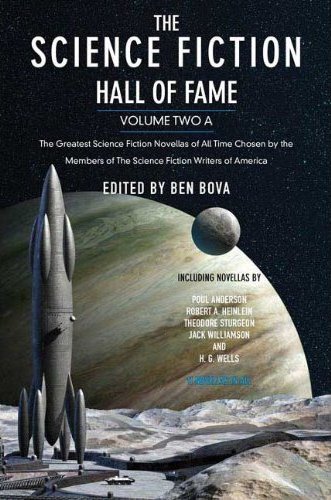
Science Fiction Hall of Fame – Volume Two A

Science Fiction Hall of Fame - Volume Two A

The more I read of science fiction from the 1930’s to 60’s, the more I realize that this was where our culture grew up in a sense it hadn’t before.  These people were dreaming the future we live in.  I don’t mean because they (good grief) “predicted” anything, but because they were pioneers of new ideas, new perspectives, new attitudes.  To fully explore all that you needed a literature without any limits, where every dial could be turned.

The format they did it best with was the short format.  Maybe it was an accident of publishing history, I don’t know.  But most of the best science fiction stories are either short stories or short novels.

For exploring the novels, have a look at the Gollancz Masterworks series.  For the rest there’s anthologies.  This is one of them.  Every story here is exceptional or historic in some way: Call Me Joe (1957) by Poul Anderson, which contains the core ideas of AvatarWho Goes There? (1938) by John W. Campbell, filmed as The ThingUniverse (1941) by Heinlein, the original degenerate generation ship story, (one echo of which is WALL-E).  The Marching Morons (1951) by C. M. Kornbluth, the basis for Idiocracy.

The deep link between science fiction and libertarianism is demonstrated in … And Then There Were None (1951) by Eric Russell, which portrays moneyless anarcho-libertarians inspired by Gandhi, and With Folded Hands (1954) by Jack Williamson, the nanny state nightmare version of Asimov’s robotic laws.

As anthologies go, this is about as good as it gets.

Frihetsfestivalen 2010

Det var kanskje ikke så lurt av Hans Jørgen Lysglimt å invitere Nyhetsspeilet-folk til Frihetsfestivalen i Oslo i dag, men du verden som det setter farge på noe så i utgangspunktet kjedelig som en politisk konferanse.  De ble fjernet fra programmet i siste liten, men var tungt tilstede blant publikum, og jeg storkoste meg med å diskutere de virkelig store linjene i verdenshistorien med folk som faktisk tror at Bilderberg-gruppen i samråd med Rothschild-familien bruker chemtrails til å forberede noe stort som skal skje i 2012, eller noe.

Og det er tross alt mer spennende å snakke med slike folk enn å høre liberalister diskutere doktrinenyanser.  Liberalister er interessante å høre på når de legger ut om sin egen filosofi.  Når de begynner å krangle med hverandre er det bare å koble ut.  Og sånne diskusjoner er vanskelig å unngå på en konferanse med utspring i liberalistmiljøet.

Foredragene jeg var på var mer virkelighetsnære enn tilhørerne.  Og jeg fant noen interessante bøker.  Og fikk snakket med noen folk jeg bare kjente online.  Så jeg liker initiativet, og håper det blir mer.

Mine personlige ønsker for neste gang: 1) Konferansen bør favne så bredt som mulig uten at det blir vissvass.  (De Grønne var tilstede med stand, og både EFN og FriBit holdt foredrag – sånt er bra).  2) Profilen bør være sær nok til at den respektable høyresiden nøler litt med å møte opp, men 3) man trenger litt velmenende diktatorisk ordstyring for å hindre publikumsdiskusjoner om pengeteori og statens opprinnelse.

40’s movies marathon – part 132

White Heat (1949, USA, Walsh)

Here’s how it goes with movie tropes: They go out of favor, then return self-aware, building on everything that came before.  That’s why you don’t need a big intro here, you just throw viewers into the middle of a James Cagney gangster story, with the dials turned to Nightmare, and they’ll know their way around.  It was the same with Key Largo.  The result is maybe the greatest gangster movie ever made.  Watched it all.

Madame Bovary (1949, USA, Minnelli)

Once in a while during a movie intro I start thinking about Ben-Hur, for no apparent reason.  And then I notice that the music is by Miklos Rozsa.  Anyway, when it concerns literary classics like this, known primarily for being a great novel, maybe I’ll read it one day, or maybe I won’t, but there’s not much bloody point watching the movie version, now is there?  Watched: 6 minutes.

The Small Back Room (1949, UK, Powell & Pressburger)

This reminds of that 1979-81 series The Sandbaggers, where we followed the manouverings and infights of the bureaucrats who stay at home while James Bonds go out into the world.  Here it’s a research center during the war.  There’s the same tone, and the same basic story: Smart people working with and against the whims of their politically apt superiors.  Watched it all.

Thirst / Törst (1949, Sweden, Bergman)

I think it’s very wicked of this young upstart “Ingmar Bergman” to make all these parodies of the works of his famous namesake.  Watched: 17 minutes.

Where everyone’s a student, if they want to be

One of the things that makes me feel privileged to be alive at this time is the amount of informative and educational material that is available online: Lectures, courses, podcasts.  It’s like all the world is now a university, every person a student.  All you have to do is flip the switch in your brain that allows you to notice it.

For me it started with The Teaching Company, who had been selling audio lecture series on tape for years before I found them online.  High quality stuff, well presented.  But they’re falling behind, with their insane pricing model and comparatively limited selection.

There’s FORA.tv, who are more oriented towards politicians, public intellectuals, and authors.  There are lots of gems to discover in their massive database.  (I post some on Twitter once in a while.)  It’s like a cauldron of ideas, some good, some bad, some fresh, some stale – and it makes you feel alive just to be connected to it.

These days I’m exploring iTunes U, which gathers all the free recordings universities and colleges are putting online.

Long-time readers may wonder why I don’t do much media criticism any more.  It’s because in a world of free, 24-episode lecture series on the modern history of France, obsessing endlessly about how your newspaper is biased and uninformative becomes just whining.  Like always complaining about how awful your city is, but never leaving.  At some point you just have to let go.  Flip the switch.  Join the new world.
40’s movies marathon – part 131

The Beautiful Blonde From Bashful Bend (1949, USA, Sturges)

Betty Grable rampaging across the West, shooting bullets and Preston Sturges’ dialogue.  Yes!  Watched it all.  An unpolished, but otherwise worthy forerunner to  Blazing Saddles.

City Across the River (1949, USA, Shane)

Did you know that Poor People often live in Slums and suffer terribly from Juvenile Delinquency?  Watching a movie that pretends to know what that is like is the least you can do about it.  Watched: 8 minutes.

Mr Belvedere Goes to College (1949, USA, Nugent)

I feel like Shirley Temple is the nemesis of this movie marathon.  She’s been there since the mid-30’s, and even now she’s still playing teenage roles.  I’d be depressed if I didn’t know  she would retire a year later.  (And btw, she’s still alive!) To be fair, though, this is quite good, with Temple playing only an ignorable minor role.  It’s the old “successful grown-up returns to college to get a formal education” ploy, featuring Sheldon Cooper from The Big Bang Theory.  I’m particularly impressed with Mr Belvedere’s familiarity with Norwegian, demonstrated in the clip above.  Watched: 7 minutes.

The Inspector General (1949, USA, Koster)

Through accidental circumstances, Danny Kaye is thought to be someone he isn’t.  Hilarity ensues.  He’s maybe the only funny comedian of the 1940’s, but I’m getting tired of Kaye.  He’s like Jim Carrey: Once you’ve seen him make one or two odd faces, you’ve seen it all.  Watched: 25 minutes.

Dick Armey, Matt Kibbe – Give Us Liberty: A Tea Party Manifesto

Dick Armey, Matt Kibbe - Give Us Liberty: A Tea Party Manifesto (2010)

There’s an image in my head that makes me smile: It’s when Clay Shirky decides to write the second edition of Here Comes Everybody, and realizes that he can’t get around writing about the Tea Party movement as the perfect illustration of “organizing without organizations”.

My own interest in the Tea Party movement is not so much their relevance to American politics, but this: Given some people who feel unease, anger and disgust with the political mainstream of their country, but don’t have the left’s traditions of grassroots mobilization to build on, how do you cause change to happen?

Because that’s me.  If Norway’s public sphere is like a friendly gettogether, with everyone chatting quietly, confident in their shared vision of the world, I’m the guy staring out the window, thinking “there has to be a way to smash all this”.  But I don’t know how.

The Tea Party movement is one of the data points I’m interested in.  They started with that same feeling, and are possibly achieving .. something.  This book explains how some of them see the world – with a bias towards the authors’ own organization FreedomWorks.  They present the movement as the marriage of fiscal conservatism with the organization tactics of the mid-20th century radical Saul Alinsky.  Their goal is to reinvent the Republican party, one elected official at a time.

Who knows if it will work, but this is the most interesting political phenomenon I’m aware of at the moment.  A new type of politics, with unexplored possibilities.