40’s movies marathon – part 93

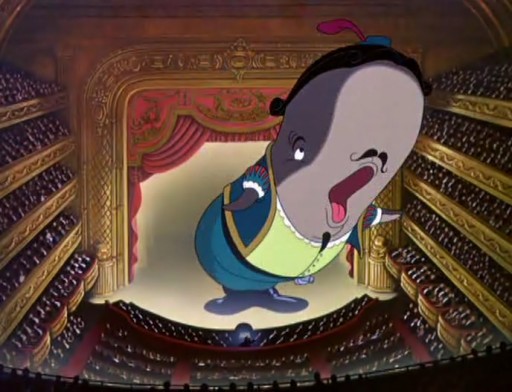
Make Mine Music (1946) - Disney - Singing Whale

Make Mine Music (1946, USA) – A cheaper-looking Fantasia.  I must find out what was going on at Disney in the mid-40’s.  They released all these mediocre movies that were also pretty inventive – and fun, especially when you don’t know what to expect.  But still mediocre.  I loved the jazz numbers, though, and the one with the singing whale.  Watched it all.

Paisan (1946, Italy, Rossellini) – Short stories from the invasion of Italy.  In the first, it seems the filmmakers just grabbed some random G.I.’s and put them in front of a camera.  Their dialogue is possibly more convincing if you don’t understand any English at all.  Watched: 10 minutes.

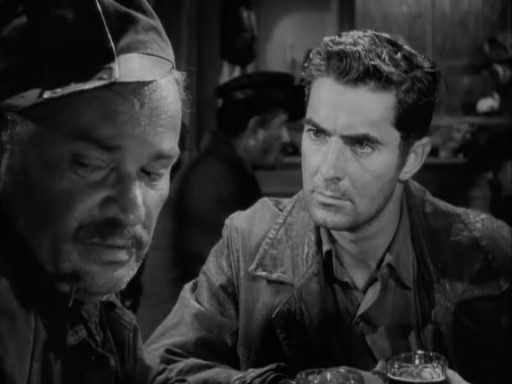
Ride the Pink Horse (1947) - Robert Montgomery

Ride the Pink Horse (1947, USA, Montgomery) – An American tough guy arrives in Mexico to take revenge on a gangster who killed his friend, but mostly he just walks calmly about town being awesome.  I think what I love most about this movie is Robert Montgomery’s voice.  Watched it all.

I Wonder Who’s Kissing Her Now (1947, USA, Bacon) – A troubadour who cares little for money and less for fame travels around the country spreading joy and harmony.  That’s what the intro text says, and I’ve decided to take it at its word.  Watched: 4 minutes.

13 Rue Madeleine (1947, USA, Hathaway) – There are right ways and wrong ways to make a spy movie.  Starting it with 6 minutes of newsreel-style exposition is one of the wrong ways.  Watched: 7 minutes.

40’s movies marathon – part 92

Ivan the Terrible - Part 2 (1947) - Nikolai Cherkasov

Ivan the Terrible – Part 2 (1946, USSR, Eisenstein) – Josef Stalin, Tsar of Muscovy, is now at the peak of his power, but there are very few people left he can trust.  Only fear keeps his underlings in line.  Watched it all.  There isn’t a single frame in this movie that isn’t carefully composed to the point of absurdity.  It’s like this isn’t a movie at all, but what movies could have been like if they’d been invented by painters.  This second part wasn’t shown until 1958, because Stalin didn’t like what he saw in the mirror.

Monsieur Beaucaire (1946, USA, Marshall) – You know, in addition to all the comedy teams of the 30’s and 40’s I don’t like, I don’t think I particularly like Bob Hope either.  I don’t ask much, only that the jokes be funny.  Watched: 12 minutes.

Bedlam (1946) - Boris Karloff, Anna Lee

Bedlam (1946, USA, Robson) – Boris Karloff is the sadistic head of an 18th century madhouse.  He clashes with an idealistic woman who thinks the inmates should be treated humanely.  The acting is stiff, (apart from Karloff), but the mood is enjoyably grim, and reminds me of Corman’s The Masque of the Red Death.  Watched it all.

Tangier (1946, USA, Waggner) – Sure, take the name of an Arab city, and throw in some Thousand And One Night-ish fonts and music.  That should do the trick.  Watched: 6 minutes.

Black Angel (1946, USA, Neill) – Some fancy dame has been murdered, and her admirers and lovers are all suspects.  I think the police should look closer at that Peter Lorre fellow, he looks fishy.  Watched: 15 minutes.

Where are the offerings of those who made vows and perished?

Once a man’s understanding has settled on something (either because it is an accepted belief or because it pleases him), it draws everything else also to support and agree with it. And if it encounters a larger number of more powerful countervailing examples, it either fails to notice them, or disregards them, or makes fine distinctions to dismiss and reject them, and all this with much dangerous prejudice, to preserve the authority of its first conceptions. So when someone was shown a votive tablet in a temple dedicated, in fulfilment of a vow, by some men who had escpaed the danger of shipwreck, and was pressed to say whether he would now recognize the divinity of the gods, he made a good reply when he retorted: ‘Where are the offerings of those who made vows and perished?’

The same method is found perhaps in every superstition, like astrology, dreams, omens, divine judgements and so on: people who take pleasure in such vanities notice the results when they are fulfilled, but ignore and overlook them when they fail, though they do fail more often than not. .. Even apart from the pleasure and vanity we mentioned, it is an innate and constant mistake in the human understanding to be much more moved and excited by affirmatives than by negatives, when rightly and properly it should make itself equally open to both; and in fact, to the contrary, in the formation of any true axiom, there is superior force in a negative instance.

– Francis Bacon, The New Organon

Behind our efforts, let there be found our efforts

Gene Wolfe - Book of the New Sun - Sword & Citadel

Reading the second part of Gene Wolfe’s The Book of the New Sun has for me been a dreamlike experience.  I gave up on the first part once because it got too weird, but now that I’m attuned to Wolfe’s style, that is no longer a problem.  Now it works like hypnosis.  A few paragraphs in, and my brain shifts to a different gear: Slow, focused. Dreamlike.

The story takes place at the end of Earth’s life, when the sun is cooling, a setting introduced in Jack Vance’s Dying Earth stories.  Everything that could happen has happened, and people are surrounded by monuments from greater times.  The end is coming, or possibly the birth of a better world.

Events follow a jagged path that seems random but at the same time full of meaning.  There are echoes of mythology: Christian, classical, and modern.  And there are events that seem meaningful at first, then turn out not to be.  The protagonist, an exiled torturer, is given a magnificently named sword at the beginning, which he carries through all his adventures.  And then he loses it, and the story continues.  It was just a sword.

A gem that brings dead people back to life is possibly just a gem, or possibly magical.  A boy that shares the torturers name seems to represent something, but we never learn what.  Questions remain unanswered, and what I’m left with afterwards is mostly the feeling that I’ve been through something wonderful, something that resonated deeply with me.  Just like a dream.

.. rather than admit their own incapacity

Nor should we attach much value to consensus itself and its longevity. There may be many kinds of political state, but there is only one state of the sciences, and it is a popular state and always will be. And among the people the kinds of learning which are most popular are those which are either controversial and combative or attractive and empty, that is, those which ensnare and those which seduce assent. This is surely why the greatest geniuses in every age have suffered violence; while men of uncommon intellect and unerstanding, simply to preserve their reputation, have submitted themselves to the judgment of time and the multitude. For this reason, if profound thoughts have occasionally flared up, they have soon been blown on by the winds of common opinion and put out.

The result is that Time like a river has brought down to us the light things that float on the surface, and has sunk what is weighty and solid. Even those authors who have assumed a kind of dictatorship in the sciences and make pronouncements about things with so much confidence, take to complaining when they recover their senses from time to time about the subtlety of nature, the depths of truth, the obscurity of things, the complexity of causes, and the weakness of human understanding; yet they are no more modest in this, since they prefer to blame the common condition of man and nature rather than admit their own incapacity.

– Francis Bacon, The New Organon

Max 256 Blog expands with five extra words

When I launched the Max 256 Blog nearly two years ago, the purpose of the word limit was to make it easy to post regularly.  All my previous blogs suffered from spiralling post lengths, to a point where, by some estimates, the length of each post, and the interval between them, increased by as much as 40% for each post. The growth was unsustainable, and drastic action had to be taken.

Judging by the number of posts since, the word limit has been a resounding success. But the success has come at a price.  In order to write blog posts that are 256 words or shorter, I often have to delete some words.  And they’re the most interesting ones too.  Exciting adjectives are first to go.  Next are repetitions, rephrasings that don’t actually add anything to what came before.  And, you know, those interjections that give writing sort of a friendly and conversational character, well, they too are deleted.

Entire paragraphs never even get written in the first place, just because the message would stay the same without them. If it doesn’t serve a clear purpose, there’s no room.

As anyone who has seen Amadeus knows, true artists never delete anything.  That’s how I remember it, anyway.

I do not plan to abandon word limits alltogether, because there are usually just a few deleted words I wish I could have kept.  So, starting with this post, I am expanding the word limit by five words, to 261.  That should be sufficient to meet my writing needs for the new decade.

40’s movies marathon – part 91

Notorious (1946) - Cary Grant, Ingrid Bergman

Notorious (1946, USA, Hitchcock) – Ingrid Bergman goes drunk driving with Cary Grant, which leads to all sorts of troubles with gangsters/anarchists/Nazis.  This may be Grant’s first serious role where I’m actually able to take him seriously.  Watched it all.  Btw, why is it that these fascists-in-hiding always have such creepy, domineering mothers?

The Bandit of Sherwood Forest (1946, USA, Levin, Sherman) – Robin Hood is possibly the most awesome story premise in the history of storytelling, but this son-of-Robin version is quite stupid: Old Robin Hood gathers together his former comrades, (who all still live in the forest, wtf?), because the Lord Regent wants to overturn the Magna Carta and thus End Freedom and Democracy.  Robin gets help from his son, who has been educated in all things Robin Hoody, up to and including the smirk. Watched: 8 minutes.

The Razor's Edge (1946) - Tyrone Power

The Razor’s Edge (1946, USA, Goulding) – Somerset Maugham’s novel about a man who goes loafing around the world in search of enlightenment has stayed with me ever since I read it at an impressionable young age.  I’ve done my searching in other ways, (the whole Indian guru thing was ahead of its time in 1944, but hasn’t aged well), but the story has always been a model for me.  It works fairly well as a movie, more superficial, but some of the message comes through.  Watched it all.

Valley of the Zombies (1946, USA, Ford) – A man jumps off a ledge with his cape flapping around him.  I guess the movie’s trying to tell us he’s a vampire.  Watched: 7 minutes.

40’s movies marathon – part 90

Pink String and Sealing Wax (1946) - Mervyn Johns

Pink String and Sealing Wax (1946, UK, Hamer) – Mervyn Johns drives his kids away by being an asshole in the good old patriarchal tradition.  He believes in sobriety, religion and respectable family life, but the kids want to hang out with loose women and do something in media and fall in love with someone outside their social class and all that.  Watched it all.

Two Guys from Milwaukee (1946, USA, Butler) – Some fancy foreign prince befriends a New York taxi driver to see how the common people live.  He’ll probably learn valuable life lessons.  Watched: 12 minutes.

Cinderella Jones (1946, USA, Berkeley) – A man dies and leaves behind a will with amusing stipulations that must be fulfilled before the movie is over.  Watched: 3 minutes.

The Captive Heart (1946) - Michael Redgrave

The Captive Heart (1946, UK, Dearden) – British officers are taken prisoners, and spend the war reading about and dreaming of home.  It’s not such a bad life.  In fact, all things considered, I think they’re pretty lucky.  Look at them, garden and everything!  Watched it all.

London Town (1946, UK, Ruggles) – A British attempt at a big, expensive, technicolor musical, Hollywood-style.   Watched: 2 minutes.  The movie was a flop – that ought to teach them.

The Story of Menstruation (1946, USA) – This Disney animated short was made for health education classes and explains that menstruation is a normal part of life.  It advises girls not to worry, but stay healthy – and stop slouching, (it looks bad).  Wikipedia says this was the first movie ever to use the word “vagina”.

Ikke noe anonymt styre med en liten Willoch som de putter frem ved enkelte anledninger

Jan Ove Ekeberg, Jan Arild Snoen - Kong Carl

Fremskrittspartiet er det ene av de to ekte opposisjonspartiene i Norge.  Det er riktignok ikke klart hva slags opposisjon de representerer.  Andre partier har politiske plattformer, FrP har personlighet, og da først og fremst Carl I. Hagens personlighet.  En vinglete, opportunistisk personlighet som har introdusert noen av de beste og de dårligste ideene i norsk politikk.

Kong Carl av Jan Ove Ekeberg og Jan Arild Snoen er ikke en god Hagen-biografi.  Vi får en skisse av personen Hagen, men den går sjelden i dybden.  Derimot er dette en interessant fremstilling av FrP’s historie, og spesielt av FrP’s personlighet, blandingen av liberalistiske, konservative og populistiske strømninger som Hagen etter et par utrenskninger til sist fant en levedyktig balanse mellom.

Det er spesielt fascinerende å lese hvordan Hagen bygget en partiorganisasjon ut av Anders Langes Parti.  ALP var ment som et anti-parti, Langes personlige folkebevegelse.  Hagen brøt med ALP nettop derfor, og det var kun Langes død som fikk ham tilbake igjen.  Lange skapte FrP helt utilsiktet.

Jeg kunne forresten tenke meg å lese mer om Anders Lange.  De puslespillbitene jeg har funnet fra hans liv gir inntrykk av en blogger før sin tid: Egenrådig og uforutsigbar, med en så sterk vilje til å dytte sine personlige meninger på folk at han stiftet både Anders Langes Avis, Anders Langes Frihetsbevegelse, og Anders Langes Parti.  Fantastisk!

Det er FrP han vil bli husket for, men jeg mistenker at Lange er en langt mer interessant person enn Hagen.  Hvor i all verden er den store Lange-biografien?

40’s movies marathon – part 89

The Big Sleep (1946) - Humphrey Bogart, Lauren Bacall

The Big Sleep (1946, USA, Hawks) – Humphrey Bogart runs around L.A. getting involved with beautiful women.  Meanwhile somebody is doing something wrong to somebody, for some reason.  The details are unclear, but whatever it is, Bogart’s not going to stand for it.  Watched it all.

The Diary of a Chambermaid (1946, USA, Renoir) – Paulette Goddard learns to think for herself and question authority.  Yay!  Watched: 11 minutes.

The Brute Man (1946, USA, Yarbrough) – The Creeper creeps again.  See House of Horrors instead.  Watched: 4 minutes. Rondo Hatton was so ugly that his film studio invented a super-villain’s origin story for him: He had suffered a gas attack during World War I, which transformed him into a movie monster.

The Best Years of Our Lives (1946) - Fredric March

The Best Years of Our Lives (1946, USA, Wyler) – The boys come home from war, some broken on the outside, and some on the inside, and they realize they’ll have to spend the rest of their lives as soda jerks and bank functionaries.  Watched it all.

The Secret Heart (1946, USA, Leonard) – June Allyson likes to be alone and play the piano.  Her psychiatrist takes us back into flashback mode to learn why.  Watched: 8 minutes.

Song of the South (1946, USA) – In the post-Civil War south, former slaves live in harmony with their former masters, and entertain themselves with fairy tales.  Disney was concerned about wandering into racial controversy here, but the larger problem is how dull this is.  Enough live-action now, Walt.  Watched: 25 minutes.